Muscle after 50
Building muscle after 50: what actually works for women
Can you build muscle after 50? Yes. After 60? Also yes. The research on this is not ambiguous. What changes after 50 is not whether muscle grows, but how much it takes to make it grow. This guide is about supplying that.
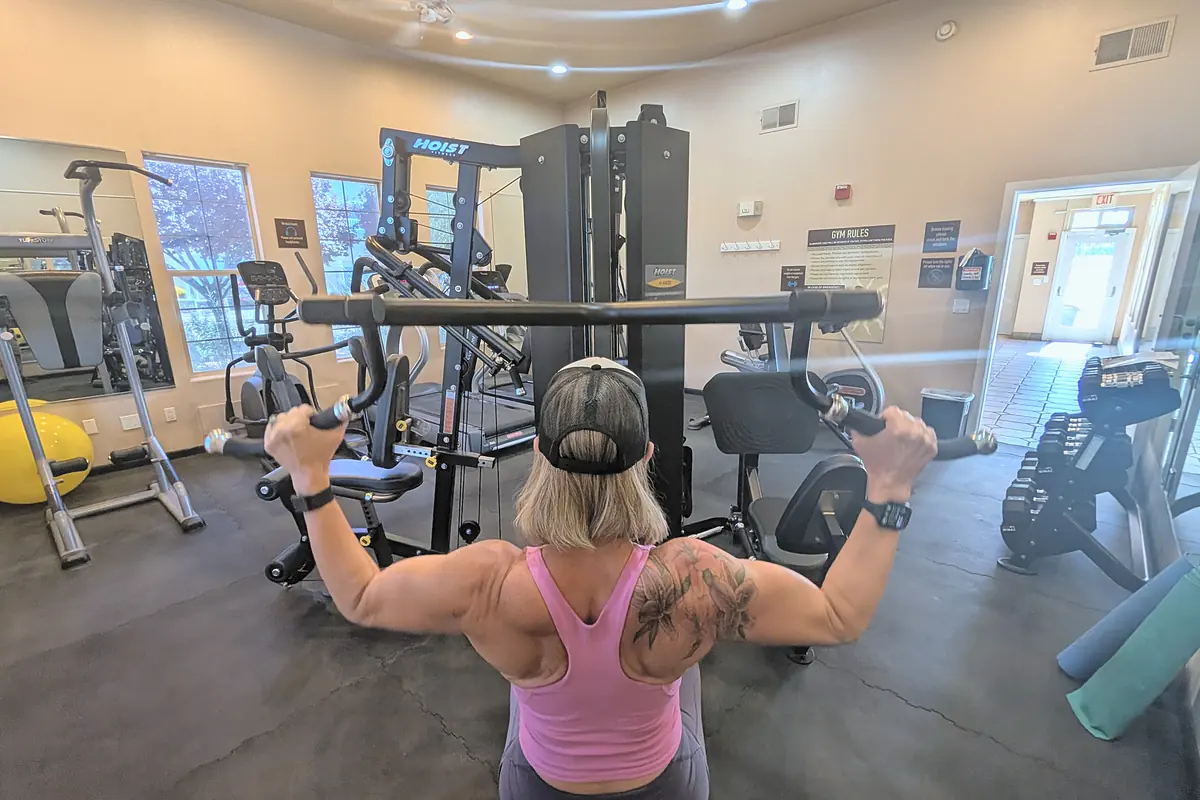
Is it harder to build muscle after 50?
From around age 30, the body loses about 3–5% of its muscle per decade if you do nothing about it. After menopause, the drop in estrogen makes muscle a little less responsive to the signals that build it. So a 55-year-old woman doing the same workout and eating the same food as a 25-year-old will build less muscle from it.
That sounds like bad news. It is actually a to-do list. Every one of those factors has a known counter, and women who apply them build muscle at every age it has been studied. In the best-known trial, people averaging 90 years old grew their thigh muscles 9% in eight weeks. Your margin is bigger than theirs.
What builds muscle after 50?
1. Lift heavy enough to matter
Muscle grows when it is asked to do something it currently can’t do easily. Light weights for high reps, the “toning” workout most women over 50 were taught, mostly don’t ask. The NSCA’s guidance for older adults is 2–3 sets at 70–85% of the most you could lift once, for the big multi-joint exercises. In plain terms: a weight where 8–12 reps is genuinely hard and the last two are a fight.
If you have never lifted, you do not start there. You start with the five basic patterns and light weights to learn them, then add load steadily. But “heavy enough” is where you are headed, and the lifting heavy after 50 guide covers how to get there safely.
2. Keep adding, a little at a time
This is called progressive overload, and it is the whole game. The weight that built muscle in March will only maintain it in June. So every session, you try to do slightly more than last time: one more rep, five more pounds, one more set. Write it down. The women who build the most muscle after 50 are almost always the ones with a notebook.
3. Eat enough protein, and spread it out
After 50, muscle responds less to a small dose of protein, so each meal needs more of it to trigger growth. Stanford Lifestyle Medicine recommends about 30 grams per meal for adults over 50. For a daily total, a large analysis of 49 trials found the muscle-building benefit of protein kept rising until about 0.73 grams per pound of body weight a day, with the upper estimate near 1 gram per pound. If you are also trying to lose fat, the sports-nutrition research supports the higher end.
In practice: a palm-and-a-half of chicken, fish or tofu, a cup of Greek yogurt, three eggs plus a glass of milk. Breakfast is where most women fall short. The protein guide and the calculator turn this into a plan.
4. Recover like it is part of the program
Muscle is built between workouts, not during them. After 50 that recovery takes a little longer, which is why three sessions a week with a day between them beats six. Sleep is where most of it happens; seven hours is the target, and the body-recomposition research explicitly lists sleep alongside training and protein as a requirement. A short walk on your off days helps recovery more than sitting still.
What stops women from building muscle after 50?
- Doing cardio instead. Cardio is good for you. It does not build muscle, and done to excess with too little food it can cost you some. Keep it, but it is the side dish.
- Eating too little. Building muscle while eating very little is possible but slow. If you are deep in a diet, the training mostly protects what you have. That is still worth doing.
- Changing the program every week. Muscle grows from doing the same movements and adding weight to them. A new routine every Monday means you never get strong at anything.
- Judging by the scale. Muscle is dense. You can build it, lose fat, and see the scale stay put. Use a tape measure, photos every four weeks, and how your jeans fit.
- Stopping at the first sore week. The first two or three weeks are the worst for soreness and the least rewarding. It gets better fast.
One supplement has real evidence for adding to this in women over 50, and it is inexpensive: creatine for women over 40.
How long does it take to build muscle after 50?
| Timeframe | What changes | What you notice |
|---|---|---|
| Weeks 1–4 | Nervous system learns the moves; strength jumps | Weights that felt heavy feel normal |
| Weeks 5–12 | Muscle fibres start to grow; posture changes | Clothes fit differently through the shoulders and legs |
| Months 3–6 | Visible muscle, especially back, arms, glutes | Someone comments. Carrying things is easy. |
| Months 6–12 | Steady gains; bone density starts to respond | You are stronger than you were at 40 |
Those are typical for a woman over 50 who trains three times a week, adds weight when she can, and eats her protein. Over 60, stretch each row a little. The direction is the same.
Why does building muscle matter after 50?
Because strength is one of the best predictors of how well you age. In more than 5,400 women over 63, every roughly 15 pounds of extra grip strength was linked to about a 15% lower risk of dying over eight years. Muscle is the thing that gets you off the floor at 80. It is worth building at 50.
If you want a program that does all four of these for you, with the weights and the protein worked out and someone checking in, book a free consultation call. The free 12-week program is a good place to start on your own.
Common questions
Can you build muscle after 60?
Yes. Muscle grows at every age it has been studied; in one trial, people averaging 90 grew their thigh muscle 9% in eight weeks. It takes heavier lifting and more protein per meal than it did when you were younger.
How much protein do women over 50 need to build muscle?
Aim for 30–35 grams at each meal. For a daily total, research shows the muscle-building benefit rising up to roughly 0.73 grams per pound of body weight, with the upper estimate near 1 gram per pound.
How long does it take to see muscle after 50?
Strength usually jumps in the first month. Visible muscle typically shows between three and six months of training three times a week and eating enough protein.
Is cardio or weights better for building muscle after 50?
Weights. Cardio is good for your heart and mood, but it doesn’t build muscle, and too much of it with too little food can cost you some.