Free tool
Protein calculator for body recomposition
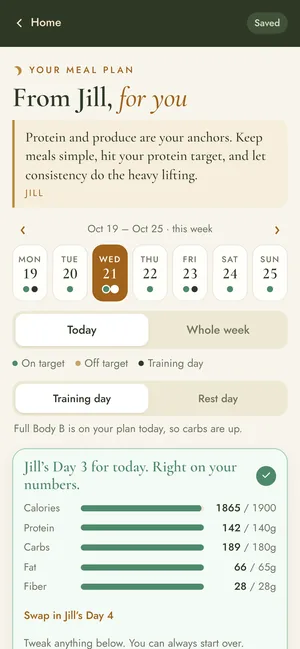
Losing fat and building muscle at the same time takes more protein than most women eat. Enter where you are and where you’re headed, then build a day of real meals that hits your number. Jill’s tips at the bottom tell you what to do next.
This tool gets you started. Jill’s coaching gets you there.
Your day
A plan is the easy part.
Anyone can build a perfect day on a screen. Sticking to it on a busy Thursday, when you're tired, traveling or stuck, is where most women get stuck. That's what coaching is for.
A free 30-minute call with Jill. No pressure to sign up.
Save my day
We'll email you this day and its grocery list, so you can follow it tomorrow. Your email also unlocks your macros and grocery list right here.
Sent from jill@nextphasephysique.com within a few minutes. Never sold or shared. Privacy
Most people don’t need another plan. They need someone in their corner. Jill checks in every week, adjusts your plan when your schedule or body changes, talks you through the hard days and keeps you accountable.Request a free consult call
Plan around what you've added?
Your day already has foods in it.
Protein first
Whatever the meal or snack, eat the protein part first. It’s the most filling thing on your plate, so it makes eating a little less far easier, and it guarantees the most important part of the plan actually gets eaten.
How the numbers work
- Daily target: about 1 gram of protein per pound of your goal weight. Using goal weight keeps the number realistic if you’re carrying extra body fat. It sits at the top of the research on purpose: the International Society of Sports Nutrition notes that higher protein during a calorie deficit helps you lose more fat and improves body composition, and a review of 49 trials put the upper estimate for protein and muscle gain at about 1 gram per pound.
- Your day: every food shows its protein for a typical serving, from food labels and USDA data. “Plan my perfect day” builds meals of 30–40 grams and fills the rest with a snack or a shake, without repeating a food. Change anything you like; Jill’s tips at the bottom keep you on target.
- Per meal: the research points to roughly 30–40 grams per meal as a comfortable, effective amount. If your meals come out much higher, add a snack or a shake.
- Timeline: the CDC notes that people who lose about 1 to 2 pounds a week are more likely to keep the weight off. Because you’re building muscle too, track your measurements and strength, not just the scale.
- Build-up plan: if you eat far less protein now, tap Adjust and start lower, then add about 20 grams a week. That pace is a coaching guideline, not a research figure.
- Macros: calories, carbs and fat are estimates for plain versions of each food; your brands may differ, and vegetables, fruit, oils and sauces aren’t counted.
Protein questions, answered
The questions women ask most about protein for body recomposition.
How much protein do I need for body recomposition?
About 1 gram per pound of your goal weight, every day. If your goal is 140 pounds, aim for about 140 grams. Recomposition means eating a little less to lose fat while lifting to build muscle, and that is exactly when protein matters most: the International Society of Sports Nutrition says higher intakes (roughly 0.7 to 1.1 grams per pound) during a calorie deficit help you lose more fat and improve body composition. The full reasoning is in the guide, how much protein you need for body recomposition. For the whole method, training included, see body recomposition for women over 40.
Should I use my current weight or my goal weight?
Your goal weight. Protein feeds muscle, not body fat, so basing the number on current weight overshoots if you’re carrying extra fat. Goal weight keeps the target realistic and points your eating at the body you’re building.
How much protein should I eat per meal?
About 30 to 40 grams. Stanford Lifestyle Medicine suggests about 30 grams per meal for adults over 50, and the ISSN points to 20 to 40 grams per serving. Spread across three or four meals, that adds up far more comfortably than one huge dinner.
Do protein shakes and snacks count?
Yes. A protein shake made with milk is about 30 grams, and protein snacks run about 7 to 20 grams; the calculator shows the exact amount for each one. Real meals come first, and a shake is an easy way to fix a light breakfast or close the gap at the end of the day.
What if I eat a lot less protein than that now?
Build up to it. Adding about 20 grams a week, starting with breakfast, gets you there without a sudden jump in how much you’re eating. That pace is a coaching guideline, not a research figure. In the calculator, tap Adjust under your daily protein to start lower.
Is that much protein safe?
For healthy adults who exercise, 1 gram per pound of goal weight sits within the range the research above studied. If you have kidney disease or have been told to limit protein, talk to your doctor before raising how much you eat.
This is a general coaching target, not a prescription. For big weight-loss goals, bring your doctor into the plan too. If you have kidney disease or have been told to limit protein, talk to your doctor before raising how much you eat.