Start here
Strength training for women over 50: the complete beginner’s guide
If you’re over 50 and have never lifted a weight, you are the person strength training helps most. Not because something is wrong with you, but because the things that change after 50 all answer to the same work: picking up something heavy, putting it down, and doing it again next week.
Why does strength training matter more after 50?
Three things are happening in the background, whether or not you train:
- Muscle leaves on its own. From around age 30, the body loses about 3–5% of its muscle mass per decade. By your fifties that adds up, and it shows up as a harder time with stairs, jars, suitcases and getting up off the floor.
- Bone is on the clock. A woman can lose up to 20% of her bone density in the five to seven years after menopause. Bone rebuilds in response to load, and lifting is the most direct way to give it some.
- Strength predicts how well you age. In a study of more than 5,400 women aged 63 and older, each roughly 15 pounds of extra grip strength was linked to about a 15% lower risk of dying over the next eight years. Strong women stay independent longer.
None of that is a reason to feel behind. It’s the reason to start.
Is it safe to start after 50?
For most healthy women, yes. The National Strength and Conditioning Association’s position is that a properly designed program with good instruction is safe for healthy older adults, and that programs can be adapted for people with mobility limits or chronic conditions. In the LIFTMOR trial, postmenopausal women with low bone mass, average age 65, built up to genuinely heavy lifting under supervision over eight months, improved their spine bone density, and had one minor adverse event in the whole study.
Check with your doctor first if you have a heart condition, high blood pressure, osteoporosis, a past fracture, a recent surgery or an injury. None of those automatically rules lifting out; they change how the plan starts.
How often and how heavy should women over 50 lift?
The NSCA recommends strength training two to three times a week, with two to three sets of the big multi-joint exercises at roughly 70–85% of the most you could lift once. In plain terms: a weight you can lift with good form for about six to twelve reps, where the last two feel genuinely hard.
What exercises should women over 50 start with?
Almost everything you do in a day is one of five movement patterns. Get strong at these and you have covered your whole body:
- Squat: stand up with load. Start with a goblet squat, one dumbbell held at your chest.
- Hinge: pick things up. Start with a dumbbell Romanian deadlift, hips back, back flat.
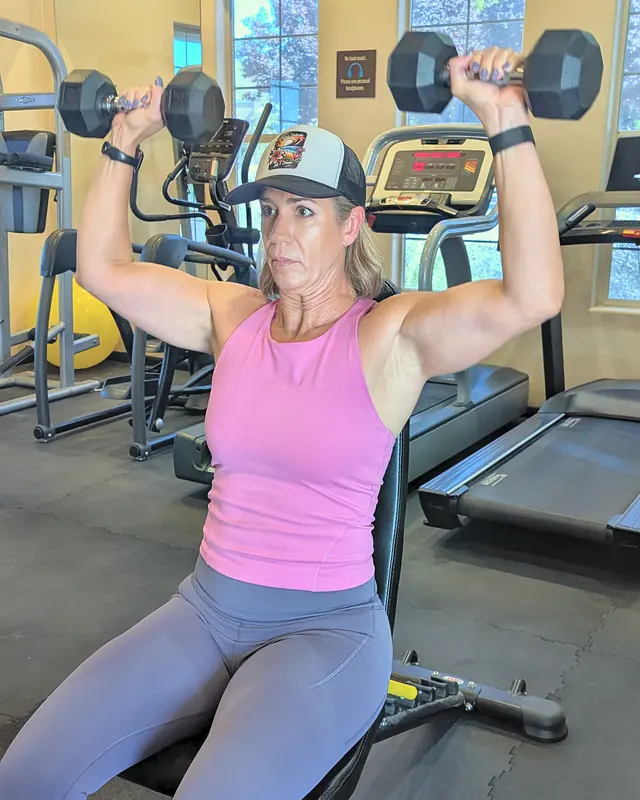
- Push: press things away. A dumbbell bench press or seated overhead press.
- Pull: bring things to you. A one-arm dumbbell row.
- Carry: hold on and walk. A farmer’s carry with heavy dumbbells, thirty seconds, standing tall.
The five moves guide has the form cues for each one.
What does a beginner strength training week look like after 50?
| Day | What you do |
|---|---|
| Monday | Lift: all five moves, 2–3 sets of 8–12 |
| Tuesday | Walk 30 minutes |
| Wednesday | Lift: all five moves, 2–3 sets of 8–12 |
| Thursday | Walk 30 minutes |
| Friday | Lift: all five moves, 2–3 sets of 8–12 |
| Weekend | Walk, rest, live your life |
A fuller version of this week, with walking, cardio and balance work placed around the lifting, is in workouts for women over 50.
That matches the CDC’s guidance of at least 150 minutes of brisk walking a week plus two or more days of muscle-strengthening activity. If you want the whole thing laid out week by week, the free 12-week program does exactly that.
How much protein do women over 50 need for strength training?
Muscle is built from protein, and most women over 50 eat well under what their training needs. Stanford Lifestyle Medicine’s baseline for adults over 50 is about 0.54 to 0.72 grams per pound of body weight a day, spread out at about 30 grams per meal. If you’re also trying to lose fat, the protein guide explains why the coaching target goes higher.
What should you expect in the first three months of lifting?
- Weeks 1–2: everything feels awkward and you’re a little sore. Normal. You’re learning patterns, not chasing exhaustion.
- Weeks 3–6: the weights go up almost every session. Most of this early strength is your nervous system learning to use the muscle you already have.
- Weeks 7–12: clothes fit differently before the scale moves much. Stairs get easier. The gym stops feeling like someone else’s room.
Measure progress by what you can lift and how you feel on the stairs, not just by the scale.
Does this work for women over 60?
The research above was done in women in their sixties, and the NSCA’s guidance covers older adults generally. Start lighter, take an extra day between sessions if you need it, and give yourself a longer warm-up. The direction is the same: learn the moves, add weight gradually, keep showing up. The over-60 guide goes through it step by step, and building muscle after 50 covers what drives growth at this age.
Form comes before weight. If anything causes sharp pain, stop and get it looked at. This guide is education, not medical advice.