The method

The five pillars of getting stronger after 40

There’s no secret program. Women who get stronger after 40 do the same five things, consistently, for a long time. This is the whole method.
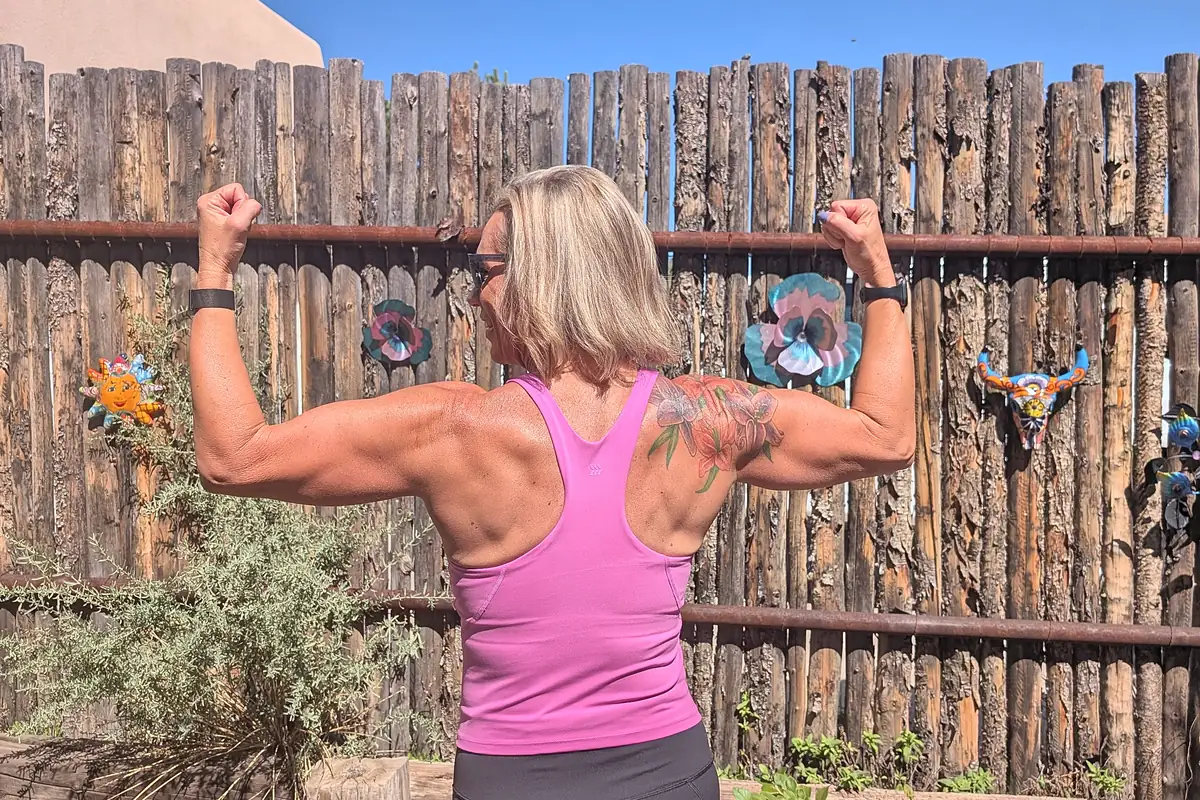
Jill from behind flexing both arms, showing her back and shoulders, in front of a wooden fence
Strength you can see, from the back too.

1. Lift heavy enough to matter

Three full-body sessions a week built on squat, hinge, push, pull and carry, heavy enough that the last two reps are actually hard. From around age 30, the body loses about 3–5% of its muscle mass per decade unless you train to keep it, and light weights you could lift all day won’t send that signal. It’s the same signal that rebuilds bone; the bone health guide has the trial data.

Rule of thumbCould you do five more reps? Then it isn’t a working set yet.

2. Eat enough protein

Protein is what turns training into muscle. The target is about 1 gram per pound of your goal weight every day. That sits at the top of the research on protein and muscle gain, where a review of 49 trials put the upper estimate at about 1 gram per pound. Many women eat well below that, then wonder why nothing is changing.

Losing fat while you build muscle has a name, and its own playbook: body recomposition for women over 40.

Start hereAbout 30 grams at breakfast. The protein guide and calculator cover the rest.

3. Walk more than you think

Walking adds up across a week in a way no single workout does, and it costs you almost nothing in recovery. A large 2025 analysis in The Lancet Public Health found that around 7,000 steps a day was linked to meaningfully lower risk of death, heart disease, dementia, depression and falls, compared with about 2,000.

TargetSeven thousand steps most days.

4. Sleep like it’s part of the plan

Muscle is built while you recover, not while you lift. Short sleep raises appetite, lowers what you can do in the gym, and quietly undoes good training.

If perimenopause is what’s wrecking your sleep, strength training for perimenopause covers training through that stretch.

TargetSeven to nine hours, in the same window every night.

5. Do it longer than feels impressive

The women who get results aren’t doing anything exotic. They’ve done the first four pillars for two years instead of six weeks.

ChoosePick a plan you’d still be doing a year from now.

That’s the whole method

We call it the Next Phase method: lift heavy enough to matter, eat about 1 gram of protein per pound of your goal weight, walk most days, protect your sleep, and keep going long enough for it to count, with a weekly check-in so it actually happens.

Lift heavy. Eat protein. Walk daily. Sleep well. Keep going. No detox, no fasted cardio, no supplement stack. It’s boring on purpose, and everything else is a detail.
You don’t have to do this alone.

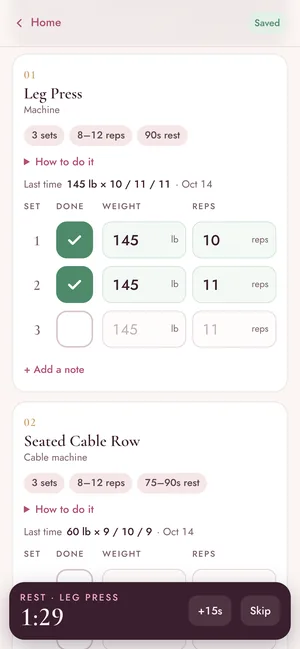
Knowing what to do is the easy part; sticking with it is where most women stall. Jill coaches women over 40 online with a plan built around you, weekly check-ins and video form checks, so you have a real person in your corner. It starts with a free 30-minute consult call.

It’s not just an app. It’s an app with accountability.

  • Your workouts and meals in your own private app
  • Every set you log goes to Jill
  • A real person checking in with you every week

Sources

  1. Morton et al., British Journal of Sports Medicine (2018): protein and resistance training meta-analysis PubMed. 49 trials, 1,863 people: the extra muscle gained from protein leveled off at about 0.73 g per pound of body weight a day, with the upper estimate reaching about 1 g per pound.
  2. Jäger et al., International Society of Sports Nutrition position stand: protein and exercise (2017) PubMed. About 0.65–0.9 g of protein per pound of body weight a day suits most people who exercise. When exercise is combined with eating less, higher intakes (two to three times the RDA, roughly 0.7–1.1 g per pound) promote greater fat loss and better body composition. About 20–40 g per serving.
  3. Ding et al., The Lancet Public Health (2025): Daily steps and health outcomes in adults PubMed. A dose-response meta-analysis of 57 studies: around 7,000 steps a day was linked to lower risk of death, heart disease, dementia, depression and falls than about 2,000.
  4. Office on Women’s Health (HHS): Sarcopenia. “Typically, sarcopenia begins around age 30, when the body naturally loses about 3–5% of its muscle mass per decade.”

This guide is general fitness and nutrition education, not medical advice. Talk with your doctor before starting a new exercise or nutrition program, especially if you have a health condition, an injury, or take medication.