The method
Body recomposition for women over 40: lose fat and build muscle at the same time
Body recomposition means losing fat and building muscle at the same time. The scale might barely move while your waist shrinks, your arms firm up and your jeans fit differently. For women over 40 it’s usually the right goal, because the old goal of “just lose weight” tends to take muscle with it.
Is it really possible to do both at once?
Yes. A 2020 review in the Strength and Conditioning Journal went through the controlled trials and found that gaining muscle while losing fat is well documented, and not only in beginners: it happens in people who already train too. The reviewers’ recommendations are the plan below: a progressive lifting program at least three times a week, a high protein intake, and sleep treated as part of the program.
In perimenopause or past menopause and seeing it mostly at the waist? Menopause belly covers why, and strength training for perimenopause covers the transition.
The people it works best for are exactly the women reading this: new or returning to lifting, carrying some extra body fat, and willing to be consistent for a few months.
What are the four levers of body recomposition?
1. Lift, and keep adding weight
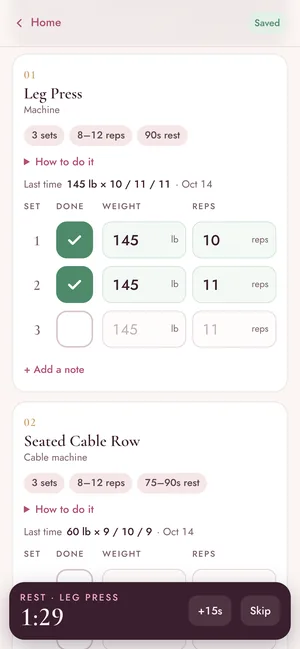
Muscle grows in response to a demand it hasn’t met before. That means three full-body sessions a week built on squat, hinge, push, pull and carry, and a weight that goes up whenever the last two reps of a set stop being hard. The NSCA’s guidance is two to three sets of the big moves at a weight you can lift for roughly six to twelve reps.
Over 50 and wondering whether the muscle side still works? It does: building muscle after 50.
2. Eat about 1 gram of protein per pound of goal weight
Protein is what turns training into muscle, and it’s the lever most women under-pull. The International Society of Sports Nutrition notes that when exercise is combined with eating less, higher protein intakes help you lose more fat and improve body composition. A review of 49 trials put the upper estimate for protein and muscle gain at about 1 gram per pound. So the coaching target is 1 gram per pound of your goal weight, spread over three or four meals.
3. Keep the calorie deficit small
A big cut strips muscle. A small one, roughly 250 to 500 calories a day below what keeps your weight steady, lets you lose fat while the lifting and protein protect the muscle. The CDC notes that people who lose about 1 to 2 pounds a week are more likely to keep it off, and with recomposition, the scale will often move slower than that while your measurements change faster.
4. Walk and sleep like they’re part of the plan
Walking burns fat without eating into recovery: a large 2025 analysis in The Lancet Public Health linked about 7,000 steps a day to meaningfully lower risk of death, heart disease, dementia, depression and falls. And muscle is built while you sleep, not while you lift. Seven to nine hours, same window every night.
What is a good body recomposition workout plan?
Three days a week, two sessions that alternate. Rest a day between lifting days.
| Session A | Session B |
|---|---|
| Goblet squat · 3 × 8–10 | Dumbbell Romanian deadlift · 3 × 8–10 |
| Dumbbell bench press · 3 × 8–10 | Seated overhead press · 3 × 8–10 |
| One-arm dumbbell row · 3 × 8–10 each | Lat pulldown or band row · 3 × 10–12 |
| Reverse lunge · 2 × 10 each | Glute bridge or hip thrust · 3 × 10–12 |
| Farmer’s carry · 3 × 30 seconds | Suitcase carry · 3 × 30 seconds each |
Week 1: A, B, A. Week 2: B, A, B. Add weight to a lift whenever you finish all sets at the top of the rep range. The free 12-week program builds this out with warm-ups and three phases.
How do you measure body recomposition progress?
- Waist and hip measurements every two weeks, same time of day.
- Photos every four weeks, same place, same light.
- The weights you lift. If your goblet squat went from 20 to 40 pounds, you built muscle, whatever the scale says.
- How clothes fit. The most honest measure there is.
Weigh yourself if you want, but treat it as one number among several. A woman who loses four pounds of fat and gains two of muscle sees a two-pound change and a different body.
How long does it take?
Expect visible change in about 8 to 12 weeks of consistent work, and meaningful change in six months. From around age 30 the body loses about 3–5% of its muscle mass per decade on its own, so some of the first few months is simply getting back what was lost. That’s fine. It still counts.
What mistakes stall body recomposition?
- Eating too little. Large deficits cost muscle, energy and sleep. Keep it small.
- Lifting the same weight for months. If the weight hasn’t gone up, the muscle has no reason to.
- Cardio instead of lifting. Walking supports the plan. It isn’t the plan.
- Judging by the scale alone. It can’t tell fat from muscle. You can.
- Quitting at week six. That’s usually right before the part that works. Knowing that, line up someone to check in with before you get there.
If you have a health condition, an injury, or a large amount of weight to lose, bring your doctor into the plan. This guide is education, not medical advice.