Strength basics

The only five moves you need to start lifting

You don’t need fifty exercises. Almost everything you do in a day is one of five movement patterns. Get strong at these five and you’ve covered your whole body.

1. Squat: stand up with load

Legs, glutes and core. It’s the pattern behind every stair, every chair, and every time you get up off the floor.

Start withA goblet squat: one dumbbell held at your chest, feet about shoulder width. Sit down between your hips, keep your chest tall, and let your knees travel in line with your toes.

2. Hinge: pick things up

Hamstrings, glutes and back. It’s the most protective pattern there is for your spine, and the one most women were never actually taught.
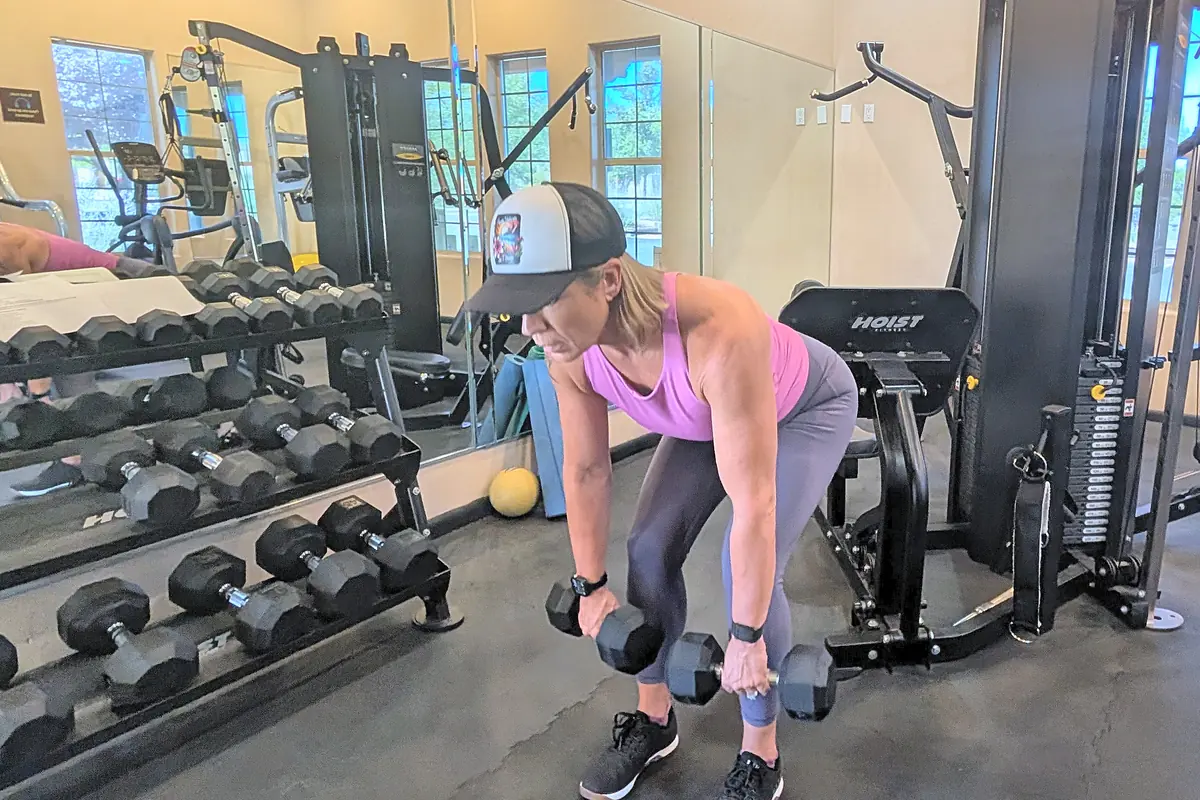
Start withA dumbbell Romanian deadlift. Soft knees, push your hips back (not down), keep the weights close to your legs and your back flat, and stand up when you feel a stretch in your hamstrings.
Jill doing a dumbbell Romanian deadlift at the gym, hips back and dumbbells close to her legs
The hinge: a dumbbell Romanian deadlift.

3. Push: press things away

Chest, shoulders and triceps. Pressing strength is what keeps the top shelf, the carry-on bag and the grandkid within reach at seventy.
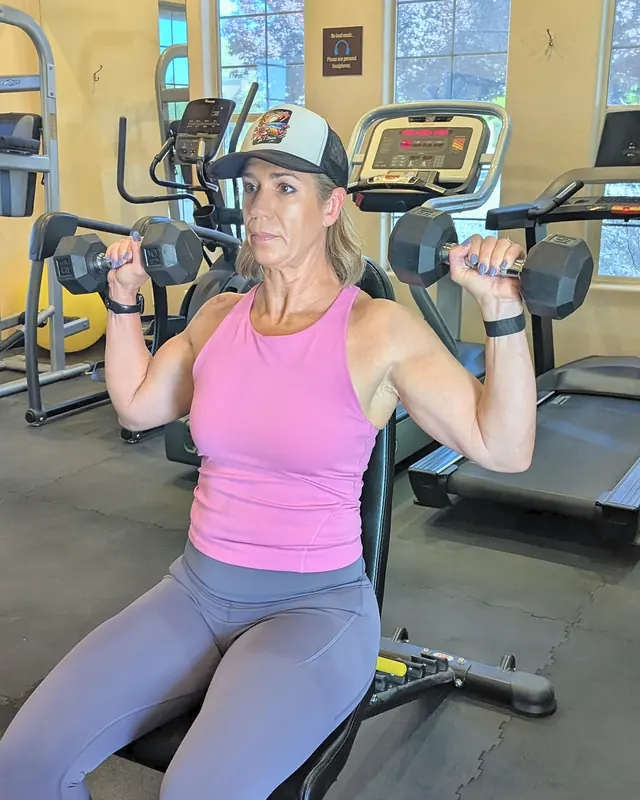
Start withA dumbbell bench press and a seated overhead press. Lower slowly, keep your ribs down, and press straight up.
Jill doing a seated dumbbell overhead press
The push: a seated overhead press.

4. Pull: bring things to you

Back and biceps. Pulling balances all that pressing, and it quietly helps the posture you’ve been blaming on your desk.
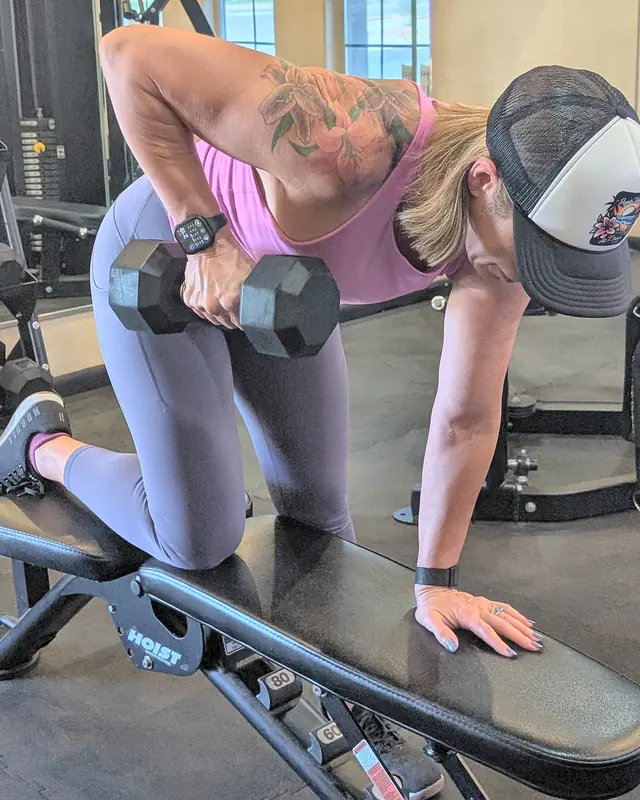
Start withA one-arm dumbbell row and a lat pulldown. Pull your elbow toward your hip, and keep your shoulders down and away from your ears.
Jill doing a one-arm dumbbell row with one knee and hand on a bench
The pull: a one-arm dumbbell row.

5. Carry: hold on and walk

Grip, core, everything. Grip strength is closely linked to how well people age: in a study of more than 5,400 women aged 63 and older, each roughly 15 pounds of extra grip strength went with about a 15% lower risk of dying over the next eight years. Carries are the simplest way to build it.

Start withA farmer’s carry: heavy dumbbells, thirty seconds, walk tall. Shoulders down, and don’t shrug.

How often should you do the five moves?

All five, three times a week. Three sets of six to ten reps. Add weight whenever the last two reps stop being hard. Loaded moves like these matter for bone as well as muscle, since a woman can lose up to 20% of her bone density in the five to seven years after menopause.

Over 60? These are still the right five moves. The loading, pace and safety notes for that decade are in strength training for women over 60.

That’s a complete program. Really. (Want it written out week by week? The free 12-week program does that.) If you’re brand new, the first 30 days guide walks you in gently. And if walking into the gym is the hard part, start with how to start when the gym feels intimidating.

Form comes before weight. If you have an injury or a health condition, check with your doctor, and stop any movement that causes sharp pain.
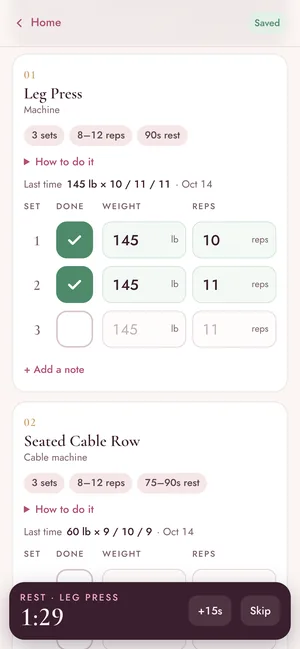
You don’t have to do this alone.

Knowing what to do is the easy part; sticking with it is where most women stall. Jill coaches women over 40 online with a plan built around you, weekly check-ins and video form checks, so you have a real person in your corner. It starts with a free 30-minute consult call.

It’s not just an app. It’s an app with accountability.

  • Your workouts and meals in your own private app
  • Every set you log goes to Jill
  • A real person checking in with you every week

Sources

  1. Harvard Health (2026): Stronger muscles after age 60 linked to longevity. In 5,400+ women aged 63 and older, each roughly 15 pounds of extra grip strength was linked to about a 15% lower risk of dying over eight years.
  2. Bone Health & Osteoporosis Foundation: What women need to know. A woman can lose up to 20% of her bone density in the five to seven years after menopause.

This guide is general fitness and nutrition education, not medical advice. Talk with your doctor before starting a new exercise or nutrition program, especially if you have a health condition, an injury, or take medication.