Over 60
Strength training for women over 60: how to start, and why it works at any age
The most common thing I hear from women over 60 is some version of “isn’t it too late?” It isn’t. The most famous strength study ever done was on people averaging 90 years old, and they got 174% stronger in eight weeks. Your body is listening. This guide is how to talk to it.

What does research say about strength training after 60?
- Muscle still grows. In 1990, researchers put ten nursing-home residents averaging 90 years old on an eight-week leg strength program. Strength gains averaged 174%, thigh muscle area grew 9%, and walking speed improved 48%. If a 90-year-old can do that, a 62-year-old can do more.
- Bone still responds. In the LIFTMOR trial, 101 postmenopausal women (average age 65) with low bone mass lifted heavy twice a week for eight months. Their spine bone density rose 2.9% while the comparison group lost 1.2%. Function improved on every measure, with one minor adverse event in the whole trial.
- Strength is tied to how long you live well. In more than 5,400 women aged 63 and older, each roughly 15 pounds of extra grip strength was linked to about a 15% lower risk of dying over eight years.
- It is safe when it is done properly. The National Strength and Conditioning Association’s position is that a well-designed program with good instruction is safe for healthy older adults, and they recommend lifting 2–3 times a week at a weight that genuinely challenges you.
What you are up against is real: the body loses about 3–5% of its muscle per decade from age 30, and a woman can lose up to 20% of her bone density in the five to seven years after menopause. But every one of those studies says the same thing. The muscle and bone you still have respond to load, and the signal works at any age.
What “strength training” means here
It does not mean a gym full of twenty-year-olds, and it does not mean chair exercises either. The National Institute on Aging lists four kinds of exercise older adults need: endurance, strength, balance and flexibility. Strength is the one most women over 60 skip, and it is the one that makes the other three easier.
Strength training means moving against a resistance that is hard enough to make the last couple of repetitions feel like work. That resistance can be a dumbbell, a kettlebell, a resistance band, a cable machine or, at first, your own body weight. The tool matters less than the effort.
What exercises should women over 60 do?
Every full program I write for women over 60 comes back to the same five patterns. They are the movements of daily life, with a little more weight.
| Pattern | Start with | Progress to | What it protects |
|---|---|---|---|
| Squat | Sit-to-stand from a chair, no hands | Goblet squat holding a dumbbell | Getting out of chairs, off the floor, up stairs |
| Hinge | Hip hinge with a dowel on your back | Dumbbell or kettlebell deadlift | Picking things up without hurting your back |
| Push | Wall push-up, then counter push-up | Dumbbell floor press or overhead press | Pushing doors, lifting things onto shelves |
| Pull | Band row | One-arm dumbbell row | Posture, shoulders, carrying |
| Carry | Walk 20 steps holding a grocery bag in each hand | Farmer’s carry with dumbbells | Grip, balance, everything you carry |
The five-moves guide has form cues for each one. If you have never done any of them, start with the first column and spend two or three weeks there before adding weight.
How often should women over 60 strength train?
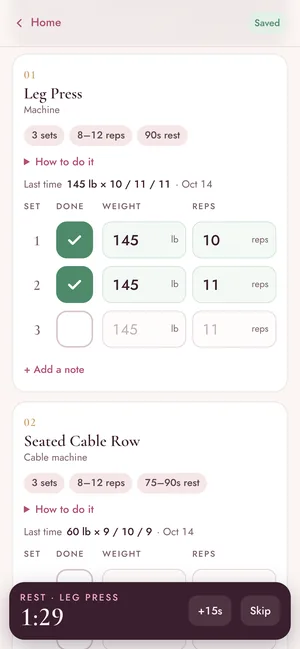
Two or three sessions a week, 30–40 minutes each, is enough. That lines up with the NSCA’s recommendation and with the CDC’s baseline of at least two muscle-strengthening days a week.
How heavy is the part most women get wrong, in the light direction. Choose a weight where you could do about two or three more repetitions than you actually do. If a set of ten feels like you could do twenty, it is too light to change anything. The weights in the LIFTMOR trial, the one that rebuilt bone, were heavy by anyone’s standard, and the women were in their mid-sixties. Build up to that over months, not days, but build up to it.
What does a weekly strength plan look like after 60?
| Day | Session | Time |
|---|---|---|
| Monday | Strength A: squat, push, carry (3 sets of 8–10 each) | 35 min |
| Tuesday | Walk, 30 minutes, easy | 30 min |
| Wednesday | Strength B: hinge, pull, carry (3 sets of 8–10 each) | 35 min |
| Thursday | Walk, plus 5 minutes of balance work (single-leg stands by the counter) | 35 min |
| Friday | Strength A again, a little heavier if last Monday felt easy | 35 min |
| Weekend | Walk, garden, hike, rest. Nothing structured. | — |
Alternate A and B each session so each pattern gets trained three times every two weeks. If three sessions is too much to start, do two and add the third when you want it.
How much protein do women over 60 need?
Muscle is built from protein, and after 60 the body needs more of it per meal to get the same response. Stanford Lifestyle Medicine’s guidance for adults over 50 is about 0.54–0.72 grams per pound of body weight a day as a baseline, with about 30 grams at each meal. Most women I work with are eating half that at breakfast. The protein guide covers what 30 grams looks like, and the calculator gives you a daily number.
Is strength training safe after 60?
- Talk to your doctor first if you have a heart condition, uncontrolled blood pressure, osteoporosis with a previous fracture, or a joint replacement. Strength training is usually still on the table; the plan just changes.
- Technique before weight. Spend the first few weeks learning each pattern with little or no load. Film yourself on your phone. It is the fastest way to see what your back is doing.
- Warm up for five minutes. A short walk and a few light sets of the first exercise. Nothing elaborate.
- Sore is fine, pain is not. Muscle soreness a day or two later is normal in the first month and fades. Sharp pain in a joint during a lift means stop and change the exercise.
- Balance is a skill. Add a minute or two of standing on one leg near a counter after your walks. Strength training improves balance on its own, but practicing it directly is cheap insurance.
What results can women over 60 expect from strength training?
The first month, most of the change is in your nervous system: the moves feel smoother and the weights that felt heavy feel normal. Months two and three, you notice it in life before you notice it in the mirror. Stairs, the garden, the suitcase into the overhead bin. Muscle you can see takes longer, and it comes.
If you would like this built around your body, your equipment and your doctor’s notes, that is what I do. Book a free consultation call and we will talk through where to start.
Common questions
Is it too late to start strength training at 60?
No. The best-known strength study was done on people averaging 90 years old, and they got 174% stronger in eight weeks. Muscle and bone respond to load at any age.
How often should women over 60 lift weights?
Two or three sessions a week of 30–40 minutes, with a day between them. That matches the National Strength and Conditioning Association’s guidance for older adults and the CDC’s baseline of at least two muscle-strengthening days a week.
How heavy should women over 60 lift?
Heavy enough that the last two or three reps of each set are hard. Start light to learn each movement, then add weight gradually over months.
Do I need to see a doctor before starting?
Talk to your doctor first if you have a heart condition, uncontrolled blood pressure, osteoporosis with a previous fracture, or a joint replacement. Strength training is usually still possible; the plan changes.