Menopause
Menopause joint pain: why it happens, what helps, and how to train
Stiff fingers in the morning, knees that complain on the stairs, hips that ache after sitting: joint pain is one of the most common and least talked-about parts of menopause. This guide explains what researchers now call the musculoskeletal syndrome of menopause, what helps, how to keep training with achy joints, and when to see a doctor.
What is the musculoskeletal syndrome of menopause?
In 2024, a group of researchers proposed the term “musculoskeletal syndrome of menopause” for a set of changes that tend to arrive together: joint pain, loss of muscle, loss of bone density and progression of osteoarthritis, among others. They estimate that “more than 70% will experience musculoskeletal symptoms and 25% will be disabled by them” through the transition from perimenopause to after menopause.
It’s a useful name because it connects things women are often told are unrelated: the sore knees, the weaker grip, the bone scan result. It’s also new. It comes from a review article, not a diagnosis every doctor uses yet, so don’t be surprised if yours hasn’t heard the term.
How common is joint pain in menopause?
Very. A 2026 review pooling studies of more than 93,000 women found muscle or joint pain in about 40% of women before menopause, 57% in perimenopause and 59% after menopause. An earlier review found about 71% of perimenopausal women reported musculoskeletal pain. The studies vary a lot in how they ask, but the direction is consistent: aches become more common through the transition.
Why does menopause make joints ache?
Estrogen probably plays a part. In the Women’s Health Initiative, women given estrogen reported joint pain a little less often than women on placebo, about 76% against 79% after a year, which the researchers called “a modest but sustained reduction.” That suggests hormones matter, but only somewhat. Whether hormone therapy is right for you is a conversation for your doctor.
Other things matter too. In an eight-year study of midlife women, aches and stiff joints were the most commonly reported symptom, and they were linked with higher body weight, low mood and going through the menopause transition. The same study noted that aches and stiffness “are not necessarily indicative of radiological osteoarthritis.” In other words, sore joints don’t automatically mean damaged joints.
Will joint pain from menopause go away?
The honest answer is that nobody knows yet. No study has followed women to see whether menopause joint pain fades once the transition is over. In the eight-year study, reports of aches increased over time, and one review found moderate-to-severe pain was more likely after menopause than before. So rather than waiting it out, it makes sense to do the things that help joints at any stage: build strength, stay active and keep moving every day.
Does strength training help menopause joint pain?
No trial has yet tested strength training for menopause joint pain specifically. But there’s strong evidence from osteoarthritis, the joint condition that becomes more common at this age:
- The American College of Rheumatology and Arthritis Foundation guideline states that “exercise is strongly recommended for patients with knee, hip, and/or hand OA,” and that most people with osteoarthritis can do some form of exercise and benefit from it.
- A Cochrane review of 44 trials found exercise reduced knee pain and improved function, with high-quality evidence.
- For hip osteoarthritis, a guideline panel found strength training gave the greatest improvements in pain, function and stiffness.
A review of menopausal joint pain reached a similar conclusion: there’s no specific treatment, and simple pain relief, weight loss and physical exercise “should be encouraged.” Strength training also protects the muscle and bone this syndrome affects, so it’s the one habit that touches every part of it.
How to train with achy joints
The aim is to load your joints enough to get stronger without flaring them. A few principles, then some swaps:
- Warm up longer. Five to ten minutes of walking or cycling, then a light set of each move.
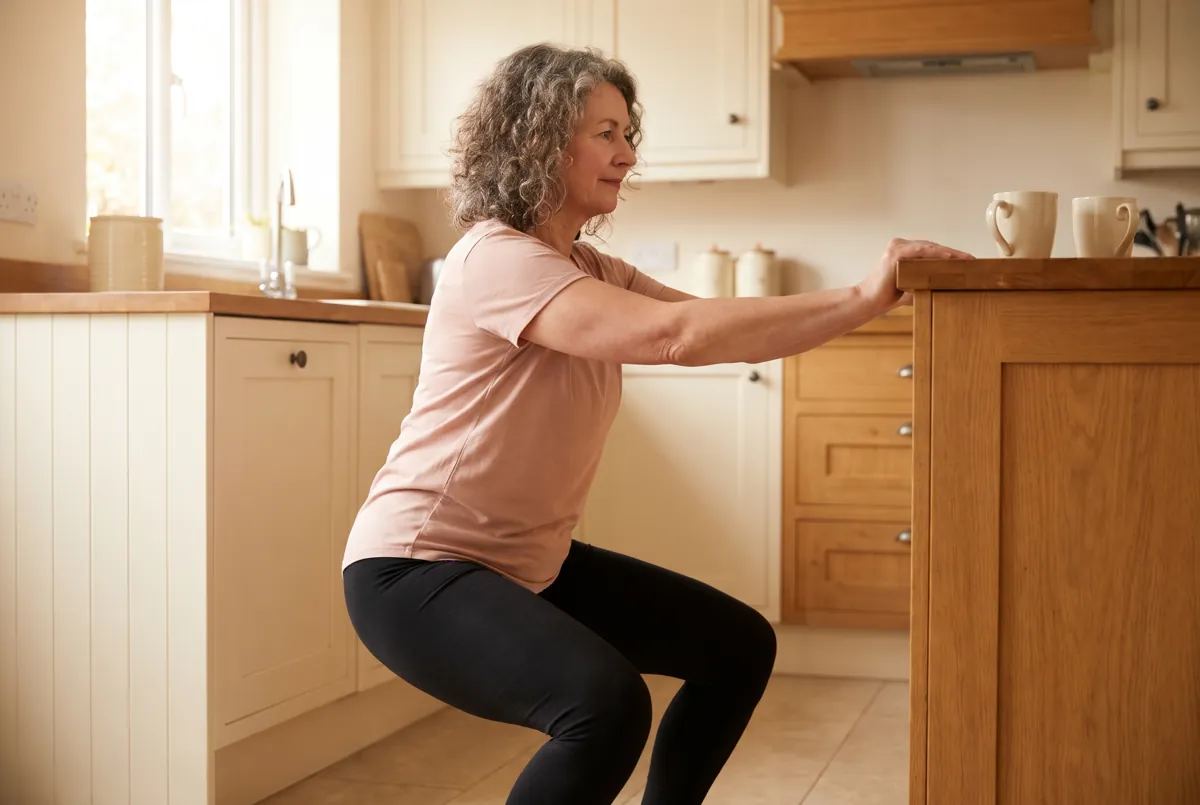
- Use a comfortable range. Squat to a box or chair instead of as deep as you can. Range can grow as the joint settles.
- Go by tomorrow, not just today. A common rule of thumb: mild discomfort during a set is OK if it settles quickly and isn’t worse the next morning. Sharp pain, or pain that builds as you go, means change the exercise. If your joints keep flaring, check with your doctor or a physical therapist.
- Move on rest days. A walk or an easy bike ride often helps stiff joints more than sitting still.
| If this aches | Try instead |
|---|---|
| Knees | Box squat to a chair, leg press with a shorter range, low step-ups, glute bridges |
| Hips | Glute bridges and hip thrusts, a narrower or wider squat stance, Romanian deadlifts with a short range |
| Hands and wrists | Dumbbells with palms facing each other, machines instead of free weights, padded handles |
| Shoulders | Presses below shoulder height, landmine press, rows; see frozen shoulder and menopause if movement is getting very limited |
For more on keeping your routine going on bad days, see how to keep lifting through perimenopause symptoms, and for a full plan to adapt, strength training for women over 50.
When should you see a doctor about joint pain?
Most menopause aches are worth mentioning to your doctor at your next visit. Some need a quicker appointment:
- a joint that is swollen, hot or red, especially if you also feel feverish or unwell;
- sudden, severe pain in a joint, or a joint you can’t move;
- stiffness that lasts a long time every morning, or pain and swelling in the small joints of both hands or feet;
- pain that wakes you at night or keeps getting worse.
Inflammatory arthritis such as rheumatoid arthritis is much less common, affecting about 5 in 1,000 people, but it’s easy to mistake for “just menopause,” and catching it matters: a review in JAMA notes that early diagnosis and treatment can prevent or substantially slow joint damage in up to 90% of patients.
If you’d like a strength plan that works around sore joints and builds up at the right pace, with someone adjusting it every week, that’s what Jill’s online coaching is for. Request your free consult to talk through what’s going on, or start with strength training for bone health after menopause.
This guide explains what research shows about joint pain around menopause. It isn’t a diagnosis or a treatment plan; see your doctor for those.
Common questions
Can menopause cause joint pain?
Joint and muscle pain is very common around menopause. A large review found about 57% of perimenopausal and 59% of postmenopausal women reported it, compared with about 40% before menopause. Falling estrogen probably plays a part, along with age, weight and mood. See your doctor for joints that are swollen, hot or red.
What is musculoskeletal syndrome of menopause?
It is a name proposed in 2024 for the group of muscle, bone and joint changes linked to menopause, including joint pain, loss of muscle, loss of bone density and progression of osteoarthritis. The authors estimate more than 70% of women have musculoskeletal symptoms through the transition and 25% are disabled by them. It is a new term, not yet a formal diagnosis everyone uses.
Will joint pain from menopause go away?
Nobody knows for sure. No study has tracked whether menopause joint pain fades after the transition, and some studies found aches stayed common or increased after menopause. What research does show is that exercise reduces arthritis pain and improves function, so building strength is worth doing either way.
Does strength training help menopause joint pain?
It has not been tested for menopause joint pain specifically, but the evidence for arthritis is strong. The American College of Rheumatology strongly recommends exercise for knee, hip and hand osteoarthritis, and a guideline panel found strength training gave the biggest improvements in hip pain and function. Start light, choose comfortable variations and build up.