Coaching · online
Perimenopause coaching, online
Perimenopause coaching, one-on-one and online: strength and nutrition coaching for women in perimenopause with Jill McCracken, ISSA-certified personal trainer. Your workouts are written for your body and your equipment, your protein targets are set for you, and a real coach checks in with you every week and adjusts the plan to the week you actually had. Coached online, anywhere in the US.
At a glance
- Who it’s for
- Women in perimenopause, usually in their 40s, whose old routine has stopped working and who want to get stronger, including women who have never lifted.
- Format
- 1-on-1 online strength and nutrition coaching, anywhere in the US.
- Coach
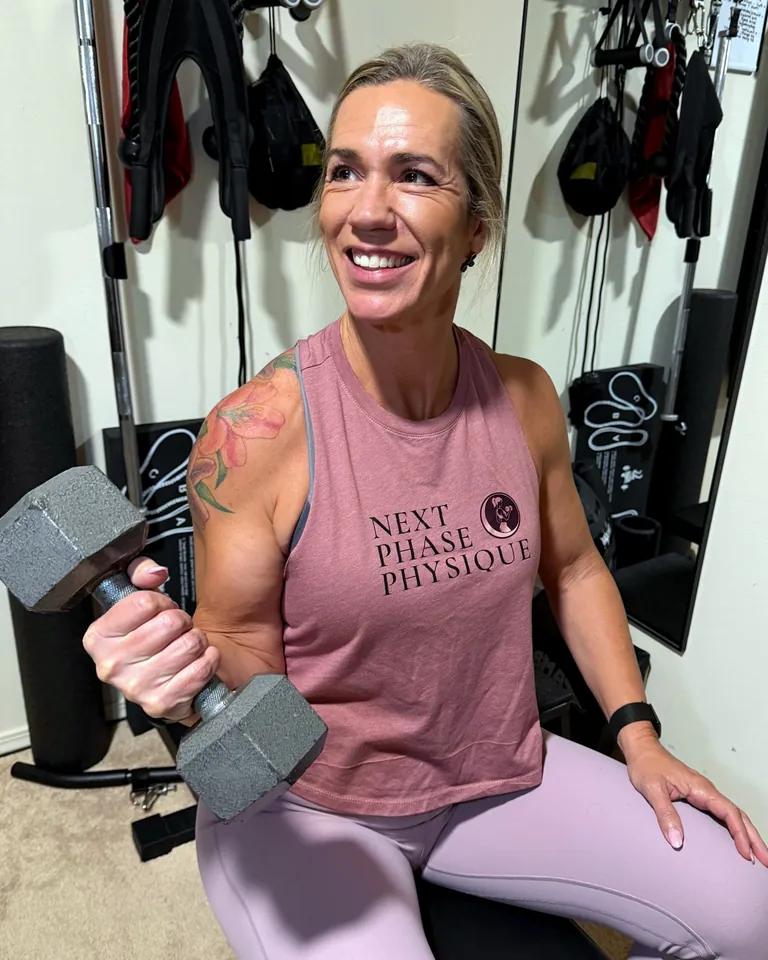
- Jill McCracken, ISSA-certified personal trainer, based in Santa Fe, New Mexico. She went through menopause without recognizing it, gained 25 pounds doing “everything right”, and rebuilt her body with strength training and enough protein. Her story
- Price
- Next Phase from $169 a month: $199 a month on a 3-month plan, $179 on 6 months, $169 on 12 months. Peak Phase: $349, $315 or $299 a month; it adds a weekly 30-minute call, a day-by-day food diary review and more form checks. See pricing
- What’s included
- Both levels: a personalized strength program; protein and macro targets, a meal plan and a swap sheet; your own app for workouts and meals; a weekly written check-in. Next Phase also includes one 30-minute call with Jill a month, 2 form-check videos a month and messages answered by the next business day.
- Terms
- Plans run for the 3, 6 or 12 months you choose. After that, coaching continues month to month at your rate, and you can stop anytime with 30 days’ notice.
- How to start
- A short inquiry, about five minutes, then a free 30-minute consult call. Request your free consult →
What changes in perimenopause, and what a perimenopause coach plans around
Perimenopause usually begins in your mid- to late 40s and lasts about four years on average, though it can last up to 10. A lot of what women notice in these years has been measured:
- Muscle and fat. In SWAN, a large study that followed women through the transition with body scans, the rate of fat gain doubled at the start of the transition and lean mass started to decline, until about two years after the final period.
- Bone. In the same study, bone loss began about a year before the final period. Women lost about 7% of their spine bone density between one year before and two years after it.
- Symptoms. In a randomized trial in women just past menopause, 15 weeks of lifting three times a week cut moderate-to-severe hot flashes by about 44%. That trial wasn’t in perimenopause, but it was the kind of training a coach writes for you now.
So a coach for this stage plans for three things: lifting that gets progressively heavier, two or three times a week, to hold on to muscle and bone; enough protein; and a plan that bends on the weeks when sleep, energy or your cycle are all over the place, so you keep going instead of quitting.
Who this is for
- You’re in your 40s or early 50s, and your periods, sleep or energy have started to change
- What used to work for your body doesn’t anymore
- You’ve never lifted, or it’s been years
- You want to build muscle and bone now, not wait until after menopause
- You want a plan built around your body, your schedule and your joints, at a gym, at home or both
What coaching with Jill includes
- A strength program built on the five core movements (squat, hinge, push, pull and carry), progressed week by week. See the five moves.
- Protein-first nutrition targets, about 1 gram of protein per pound of your goal weight, not restrictive diets, with a meal plan in your app. Find your number.
- Check-ins every week, at minimum, with the plan adjusted to the week you had, and messages in between when something comes up
- Video form feedback, so you know your technique is right before the weight goes up
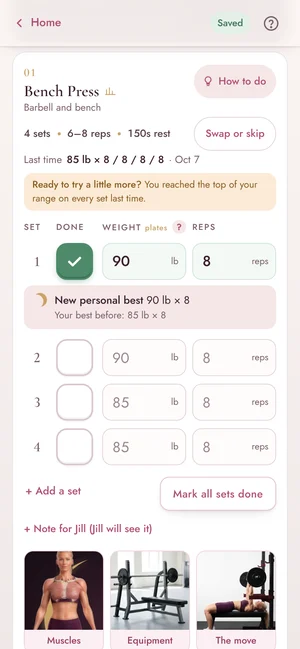
- Your own app with your workouts and meals. Every set you log goes to Jill. Try the app yourself.
What it costs
There are two levels of online coaching, and every plan starts with a free consult. Plans run 3, 6 or 12 months; the longer the plan, the lower the monthly price.
- Next Phase: $199 a month on a 3-month plan, $179 on 6 months, $169 on 12 months.
- Peak Phase: $349, $315 or $299 a month. It adds a weekly 30-minute call, a day-by-day food diary review and more form checks.
See everything each plan includes → Comparing options? Here’s what an online personal trainer costs, from apps to a trainer at the gym, and an honest comparison of a coach, a trainer and an app.
How to start
- Send a short inquiryAbout five minutes: your goals, your starting point, and what’s gotten in the way.
- Free consult callWe talk it through. There’s no pressure to sign up.
- Your starting pointJill’s intake questions in your app, plus a look at your baseline strength.
- Your planTraining and protein targets built around you.
- Train and check inWeekly check-ins, form feedback, and the plan evolves as you get stronger.
The how it works page walks through each step. Ready now? Request your free consult.
About Jill
Jill McCracken is an ISSA-certified personal trainer who coaches women over 40, 50 and 60 online from Santa Fe, New Mexico. She went through menopause without recognizing it, gained 25 pounds doing “everything right”, and rebuilt her body with strength training and enough protein. That is what she coaches now, with check-ins every week, because accountability is what makes it stick. In her words: “I coach women in perimenopause, menopause and after.” Read her story.
Jill is a strength coach, not a doctor or dietitian. Hormone therapy and other medical decisions stay with your doctor, and coaching works around whatever you decide together. If you have a health condition, a past injury or a past fracture, check with your doctor before you start.
Common questions
Can I start strength training in perimenopause if I’ve never lifted?
Yes. Most clients start by learning five basic movements with light weights, then add load week by week. Perimenopause is a good time to start: in a large study that followed women through the transition, muscle loss and bone loss sped up during the transition itself, not only after the last period.
Will lifting help with perimenopause symptoms?
It may help with some. In a randomized trial in women just past menopause (average age 55), lifting three times a week for 15 weeks cut moderate-to-severe hot flashes by about 44%, compared with about 2% in women who didn’t train. Research in perimenopause itself is thinner, so the main reason to lift now is to keep your muscle and bone.
Do I need a gym?
No. A pair of dumbbells, a resistance band and a sturdy chair cover all five movement patterns. Your program is written for the equipment you have, at a gym, at home or both. No equipment yet? Jill can start you with bodyweight exercises and walking.
How much does perimenopause coaching cost?
With Jill, Next Phase coaching is $169 to $199 a month and Peak Phase $299 to $349 a month, depending on whether you choose a 12-, 6- or 3-month plan. Every plan starts with a free 30-minute consult call. One-on-one online coaching in general often runs about $150 to $300 a month; here’s what each kind of support costs.