Weekly plan
Workouts for women over 50: a weekly plan that builds strength
Search “workouts for women over 50” and you get a thousand different videos. Most of them are missing the one thing that matters most at this age, which is picking up something heavy. Here is the whole week, with the weights where they belong.
What a good week looks like
The best workout plan for women over 50 has three parts, and they are not equal:
- Weight lifting, 2–3 times a week. This is the part that builds muscle, protects bone, and changes your shape. It is non-negotiable.
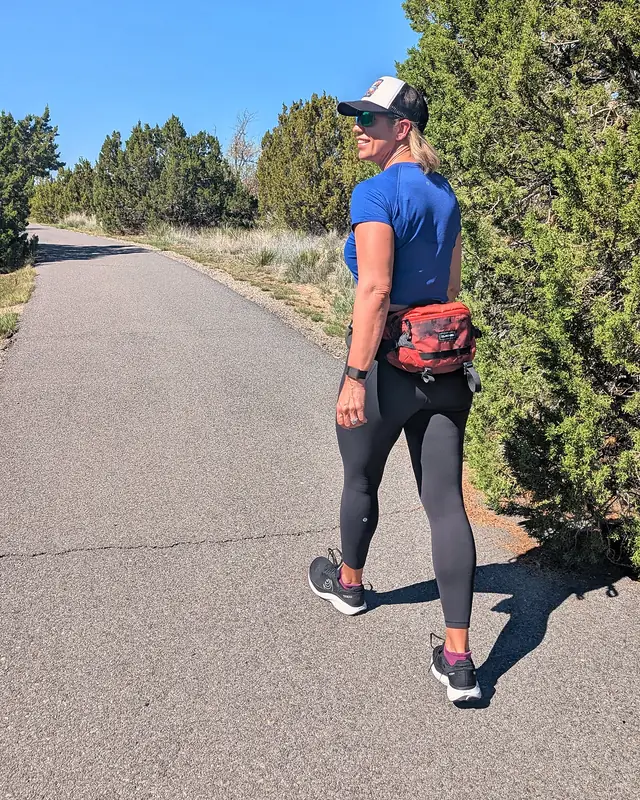
- Walking, most days. This is your cardio. It is also your recovery, your mood and your sleep.
- Balance and mobility, a few minutes a week. Cheap insurance against falls. It fits inside the other two.
That order matters. The CDC asks for at least two strength days a week plus 150 minutes of moderate activity, and the National Institute on Aging puts strength alongside endurance, balance and flexibility as the four things older adults need. Most women over 50 have the walking covered and the strength missing.
The weekly plan
| Day | Workout | Time |
|---|---|---|
| Monday | Weights A | 40 min |
| Tuesday | Walk 30–45 min | 30–45 min |
| Wednesday | Weights B | 40 min |
| Thursday | Walk, plus 5 min balance | 35–50 min |
| Friday | Weights A (next week: B) | 40 min |
| Saturday | Something you enjoy: hike, bike, swim, dance | Whatever it takes |
| Sunday | Rest or an easy walk | — |
Weights A and B: the exercises
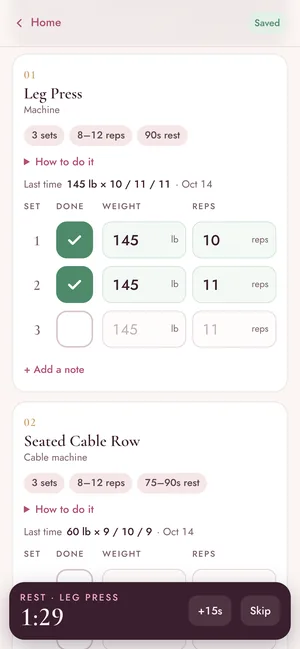
Both workouts use the same five patterns. A emphasizes the front of the body and B the back. Do 3 sets of 8–12 reps of each, resting 60–90 seconds between sets, with a weight that makes the last two reps hard.
| Weights A | Weights B |
|---|---|
| Goblet squat | Dumbbell deadlift |
| Dumbbell floor press or push-up | One-arm dumbbell row |
| Step-up to a low box | Glute bridge, then single-leg |
| Band row | Dumbbell overhead press |
| Farmer’s carry, 40 steps | Suitcase carry (one side), 40 steps each |
Form cues for each are in the five-moves guide. The free 12-week program writes this out week by week with a printable log, and it works just as well at 55 as at 45.
How heavy should women over 50 lift?
Heavier than you think. The NSCA’s position for older adults is 70–85% of your one-rep max for the big lifts, which means a weight you could lift roughly 6–12 times and no more. In the LIFTMOR trial, women in their mid-sixties with low bone mass trained at that intensity twice a week and gained spine bone density while the comparison group lost it. The light-weights-high-reps approach does not send that signal.
You build up to it. Weeks one and two are for learning the moves with light weight. From week three, add a little weight whenever a set feels like you had three or more reps left.
What is the best cardio for women over 50?
Walking is the best cardio for most women over 50, and the research is strong. A 2025 analysis of 57 studies found that about 7,000 steps a day was linked to lower risk of death, heart disease, dementia, depression and falls than 2,000. You do not need to run, and you do not need to burn yourself out in a class to get the benefit.
If you like harder cardio, one session a week is plenty, and it should not be the day before or after a weights session if you can help it. Keep it short, 20 minutes of intervals on a bike or hills on a walk. The thing to avoid is the pattern many of us were taught: cardio every day, as hard as possible, to burn calories. It leaves nothing for the weights, and the weights are what change your body.
Can strength training help with hot flashes?
If you are still having hot flashes, a strength program may help with that too. In a 15-week randomized trial, postmenopausal women who lifted three times a week had about 44% fewer moderate-to-severe hot flashes, while the group that didn’t lift saw almost no change. That is one more reason the weights come first.
Still in the transition? Strength training for perimenopause covers it, and menopause belly covers the fat that moves to your middle.
Balance and mobility, in five minutes
- Stand on one leg next to the counter, 30 seconds a side. When that is easy, close your eyes.
- Heel-to-toe walk down the hallway and back.
- Sit-to-stand from a chair, ten times, no hands.
- After weights: a hip flexor stretch and a doorway chest stretch, 30 seconds each.
Do these after a walk twice a week. Strength training improves balance on its own; this makes it faster.
How should women over 50 track progress?
Not the scale. Track the weights you lift (they should go up most weeks), your steps (aim at 7,000 and let it drift higher), and a photo every four weeks in the same spot. The body loses 3–5% of its muscle per decade after 30 if nothing is done; the lifts going up is the proof that you are doing something.
Why the scale can stall while your body changes: body recomposition, explained.
If you also want the one supplement with evidence behind it for strength at this age, read creatine for women over 40.
Want this built for your schedule, your equipment and your knees? Book a free consultation call. Coaching is online, so it works wherever you are.
Common questions
How many days a week should a woman over 50 work out?
Lift weights two or three days a week and walk most days. One more day of something you enjoy, like hiking or swimming, is a bonus.
What is the best cardio for women over 50?
Walking. Around 7,000 steps a day is linked to lower risk of death, heart disease, dementia, depression and falls. If you like harder cardio, one short session a week is plenty.
Can I do these workouts at home?
Yes. Two or three pairs of dumbbells and a resistance band are enough for both weight workouts in this plan.
Should women over 50 lift heavy weights?
Yes, built up to gradually. Guidance for older adults is a weight you can lift about 6–12 times with good form, and heavy training improved bone density in women in their mid-sixties.