Home workout
Home dumbbell workouts for women over 40: three days, one pair of dumbbells
You don’t need a gym to get stronger after 40. One pair of dumbbells, a sturdy chair and about 35 minutes, three times a week, is a real strength program. Here is the whole thing, and how to keep it working once the dumbbells start to feel light.
What you need
One pair of dumbbells (adjustable ones grow with you, but a fixed pair is fine to start), a sturdy chair or bench, and a patch of floor the size of a yoga mat. That’s it. The CDC asks adults for at least two days a week of muscle-strengthening work, so three sessions covers it with a day to spare.
What weight dumbbells should you start with?
With one pair, choose for your upper body: the weight you can row about 12 times with good form, with the last two reps feeling hard. For many women starting out that’s around 12–20 pounds, but go by the feel, not the number. Your legs are stronger, so the same pair will feel light for squats sooner. The progression section shows how to make it harder without buying more.
The weekly schedule
| Day | Workout | Time |
|---|---|---|
| Monday | Workout 1 | 35 min |
| Tuesday | Walk | 30 min or more |
| Wednesday | Workout 2 | 35 min |
| Thursday | Walk | 30 min or more |
| Friday | Workout 3 | 35 min |
| Weekend | Walk, hike, or rest | — |
Pressed for time on a busy week? 30-minute strength workouts shows how to fit a full session into half an hour.
Any three non-consecutive days work. Tuesday, Thursday and Saturday is just as good. Start every session with five minutes of warm-up: march in place, ten bodyweight squats, ten hip hinges with your hands on your hips, and some arm circles.
The three workouts
Each workout covers the five patterns: squat, hinge, push, pull, and carry or core. Do 3 sets of each move, resting 60–90 seconds between sets. Pick a weight, or a version of the move, that leaves you about two good reps short of failure on the last set.
| Workout 1 | Workout 2 | Workout 3 |
|---|---|---|
| Goblet squat, 8–12 | Reverse lunge, 8–10 each leg | Step-up, 8–10 each leg |
| Romanian deadlift, 8–12 | Glute bridge with a dumbbell, 10–15 | Single-leg Romanian deadlift, 8–10 each leg |
| Floor press, 8–12 | Overhead press, 8–12 | Incline push-up, 6–12 |
| One-arm row, 10–12 each arm | Bent-over row, 10–12 | Bent-over reverse fly, 12–15 |
| Farmer’s carry, 40 steps | Suitcase carry, 40 steps each side | Dead bug, 8 each side |
How to do each move
Goblet squat. Hold one dumbbell upright at your chest. Sit your hips down between your heels, chest tall, then push the floor away to stand.
Reverse lunge. Step one foot back and lower until both knees bend to about 90 degrees, then drive through the front heel. Hold a counter if balance is shaky.
Step-up. Whole foot on a sturdy step, knee height or lower. Stand up through that heel without pushing off the back foot, then lower slowly.
Romanian deadlift. Knees soft, push your hips back and slide the dumbbells down your thighs until your hamstrings stretch, back flat. Squeeze your glutes to stand. For the single-leg version, hold one dumbbell and touch a wall for balance.
Glute bridge. On your back, knees bent, a dumbbell across your hips. Drive through your heels until your body is straight from knees to shoulders, and pause.
Floor press. On your back, dumbbells above your chest. Lower until your upper arms touch the floor, then press up.
Overhead press. Dumbbells at your shoulders, stomach braced. Press straight up without leaning back.
Incline push-up. Hands on a counter or sturdy chair, body straight. Lower your chest to the edge and push away. Lower surfaces are harder.
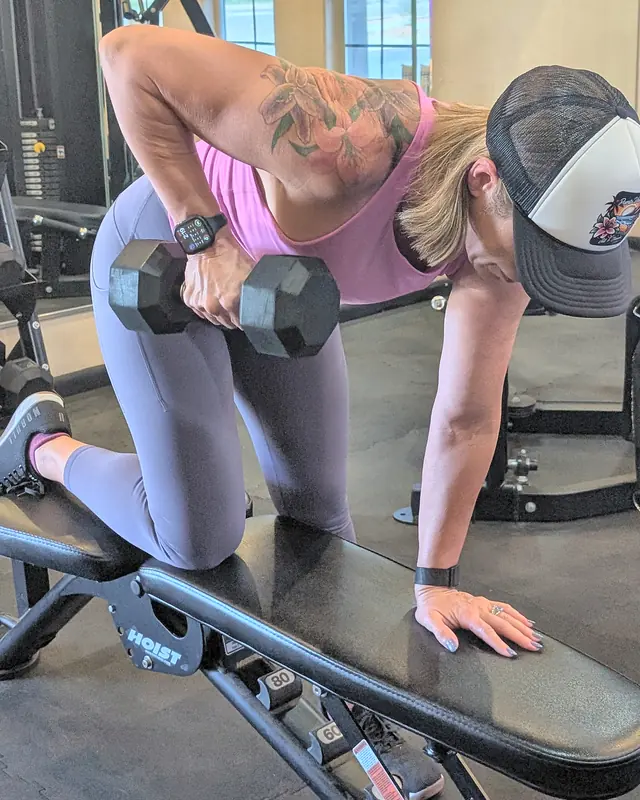
Rows and reverse fly. For the one-arm row, put a hand and knee on a bench and pull your elbow toward your hip. For the bent-over row, hinge forward with a flat back and pull both elbows back. For the reverse fly, lift slightly bent arms out to the sides.
Carries. Walk tall with a dumbbell in each hand (farmer’s) or in one hand (suitcase) without leaning.
Dead bug. On your back, arms up, knees over hips. Lower the opposite arm and leg while your lower back stays down.
Want the beginner versions and more form cues? The five moves guide breaks down each pattern.
How to progress with one pair of dumbbells
Getting stronger means doing a little more over time. With one pair you have more options than adding weight. Use them in this order:
- Add reps. When you hit the top of the rep range on all three sets, it’s time for the next step.
- Slow the lowering to three seconds a rep.
- Add a pause of two seconds at the hardest point, like the bottom of the squat.
- Go one-sided. The same load on one leg or arm roughly doubles the work for that side (see the table).
- Add a fourth set to the moves that still feel easy.
- Buy the next pair. When all of that feels manageable, go up about 5 pounds, or switch to adjustable dumbbells.
| Start with | Then | Then |
|---|---|---|
| Goblet squat | Split squat | Back foot on a chair (Bulgarian split squat) |
| Romanian deadlift | Staggered-stance RDL | Single-leg RDL |
| Glute bridge | Shoulders on a sofa (hip thrust) | Single-leg hip thrust |
| Incline push-up on a counter | Push-up on a chair or step | Push-up on the floor |
| Floor press, both arms | Floor press, alternating arms | One-arm floor press |
Change one thing at a time, and only when the current version feels solid.
Lifting is half of it. To build muscle you need enough protein too: how much protein women over 40 need.
What to track
Write down the move, the weight and the reps every session. The numbers going up are your proof it’s working, even in weeks the scale doesn’t move. The free 12-week program has a printable log you can use for this routine.
Just starting out? Your first 30 days of lifting shows how to ease into the first month without overdoing it.
Want this built around your home, your dumbbells and your schedule? Request a free consult call. Coaching is online, so your plan comes to you, along with video form checks and a weekly check-in.
New to exercise, or managing a health condition or injury? Check with your doctor before you start. Stop any movement that causes sharp pain.
Common questions
Can you build muscle with just dumbbells at home?
Yes. Muscle responds to effort, not to where you train. If the last couple of reps of each set are hard and you make the work harder over time, a pair of dumbbells at home builds strength.
What weight dumbbells should a woman over 40 start with?
Choose a pair you can row about 12 times with good form, with the last two reps feeling hard. For many beginners that is around 12–20 pounds. Adjustable dumbbells let you go heavier for your legs.
How long should a home dumbbell workout take?
About 35 minutes including a five-minute warm-up: five moves, three sets each, with 60–90 seconds of rest between sets.