Busy schedules
30-minute strength workouts for busy women over 40: gym and home
“I don’t have time” is the reason I hear most often for not lifting. You don’t need an hour, though. Thirty focused minutes, two or three times a week, is enough to get stronger, as long as you spend them on the right things.
Is 30 minutes enough to build strength after 40?
For most women, yes. The CDC asks adults for at least two days a week of muscle-strengthening activity, and nothing in that says each session has to be long. A 2021 review of time-efficient strength training came to the same practical conclusion: what matters most is the total number of hard sets you do each week, not how long you spend in the gym. The authors suggested at least four hard sets per muscle group per week, in the 6–15 rep range, as a minimum that works.
Two 30-minute sessions with three sets of each move gets you there. Three gets you further. The catch is that every minute has to count.
How to structure the 30 minutes
Every session follows the same template:
| Time | What you do |
|---|---|
| 0–5 min | Warm-up: 2–3 minutes of easy movement, then a light set of your first two exercises |
| 5–15 min | Pair 1: a lower-body move and an upper-body move, back to back, 3 rounds |
| 15–25 min | Pair 2: a second lower-body move and a second upper-body move, 3 rounds |
| 25–29 min | Finisher: a loaded carry, 3 rounds |
| 29–30 min | Write down every weight and rep |
The time-saver is the pairing. Do a set of the first move, rest about 30 seconds, do a set of the second move, then rest 60–90 seconds and repeat. Because the two moves work different muscles, one rests while the other works. That cuts your session time roughly in half compared with doing every set of one move before starting the next, without cutting the work.
Every pair covers the five patterns that matter most: squat, hinge, push, pull and carry. If any of those are new to you, start with the five-moves guide for form cues.
Sample workout 1: the gym
Do 3 sets of each, with a weight you could lift only two or three more times than the reps listed.
| Block | Exercise | Sets × reps |
|---|---|---|
| Pair 1 | Goblet squat or leg press | 3 × 8–10 |
| Pair 1 | Dumbbell bench press | 3 × 8–10 |
| Pair 2 | Dumbbell Romanian deadlift | 3 × 8–10 |
| Pair 2 | Lat pulldown or seated cable row | 3 × 10–12 |
| Finisher | Farmer’s carry | 3 × 40 steps |
Set up both stations for a pair before you start. The gym guide helps with the first few visits.
Sample workout 2: at home
You need two or three pairs of dumbbells (something like 10, 15 and 25 pounds to start), a sturdy chair or bench, and a bit of floor.
| Block | Exercise | Sets × reps |
|---|---|---|
| Pair 1 | Dumbbell goblet squat | 3 × 10–12 |
| Pair 1 | Push-up (hands on a counter, bench or floor) | 3 × 8–12 |
| Pair 2 | Dumbbell Romanian deadlift | 3 × 10–12 |
| Pair 2 | One-arm dumbbell row, hand on the chair | 3 × 10–12 each side |
| Finisher | Suitcase carry, one dumbbell | 3 × 30 steps each side |
The reps run a little higher at home because your heaviest dumbbell will feel light sooner than a gym rack would. That’s fine. Anything from about 6 to 15 reps builds muscle, as long as the last couple are hard.
Only have one pair of dumbbells? Home dumbbell workouts for women over 40 is a three-day routine built around a single pair, with ways to keep it challenging as you get stronger.
How to keep progressing
A short workout only keeps working if it keeps getting harder.
- Use one simple rule. Each exercise has a rep range. When you hit the top of it on all three sets with good form, add weight next time: 2.5–5 pounds for upper-body moves, 5–10 pounds for lower-body moves. Then work back up the range.
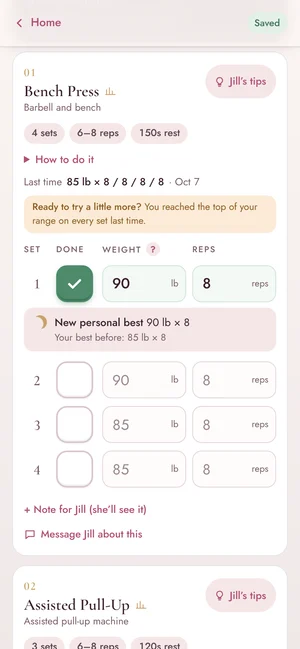
- Write it down. You can’t add weight on purpose if you don’t remember what you lifted last week.
- When the dumbbells run out at home, make the same weight harder: lower each rep over three seconds, pause at the bottom, or switch to one-leg versions like a split squat or a single-leg Romanian deadlift.
- Add a session before you add minutes. Going from two sessions a week to three is a bigger step forward than stretching each one to 45 minutes.
- Every 6–8 weeks, change the exercise, not the pattern. Swap the goblet squat for a split squat, for example.
The National Strength and Conditioning Association’s guidance for older adults lands on a weight you can lift roughly 6–12 times for the big lifts. Build up to it over a few weeks.
What to cut when time is short
- Long warm-ups. A few minutes of easy movement and a light first set of the exercise you’re about to do is enough.
- Isolation moves. Curls and leg extensions are fine on a long day. On a short one, the five big patterns come first.
- Cardio before lifting. Walk on your other days or after dinner instead. Lift while you’re fresh.
- Your phone between sets. Keep a timer running and your log open, nothing else.
If you want this laid out week by week, the free 12-week program uses the same moves in three short sessions a week, with a printable log. And the weekly plan for women over 50 shows where walking and balance work fit around your lifting days.
Want a 30-minute plan built for your schedule, your equipment and your body? Request a free consult. Coaching is online, so it works wherever you train.
Common questions
How many 30-minute strength workouts a week do I need?
Two is the minimum that works, and three is better if you can fit it. Leave at least a day between full-body sessions.
Can I split one workout into two 15-minute sessions?
On a hectic day, yes. Do Pair 1 in the morning and Pair 2 later. Fifteen minutes of real work beats skipping the day.
Should I do cardio on the same day?
If you do, lift first. Walking most days is the easiest way to fit cardio around 30-minute strength sessions.
What if I only have 20 minutes?
Do the warm-up and both pairs, and drop the carry. Keep the three sets of each move; that’s where the results come from.