Choosing a coach
How to choose an online fitness coach after 40: a checklist
You’ve decided you want help, and now every coach online looks the same: a smiling photo, a before-and-after, a “book a call” button. Here’s how to tell them apart before you spend a dollar, written by a coach who would rather you choose well than choose me.
What should you decide before you start looking?
Start with what has stopped you before, because that’s what you’re really paying to fix. If you don’t know what to do in the gym, almost any decent program helps. If you start strong and fade by week three, you need someone checking in every week. If your body isn’t changing even though you train, the missing piece is often food.
Then decide what kind of help fits your life and budget. If you’re still choosing between a coach, a trainer at the gym and an app, read online coaching vs a personal trainer vs an app first. For typical prices at each level, see what an online personal trainer costs.
What credentials should an online fitness coach have?
At minimum, a personal trainer certification from a recognized organization, kept current with continuing education. Many certifications are accredited by the National Commission for Certifying Agencies (NCCA), the standard many gyms use when they hire, and some organizations offer both an accredited exam and a non-accredited version. Ask which certification a coach holds and when they last renewed it.
A certificate is the floor, not the finish line. After 40, experience matters just as much. Ask how many of their clients are women in their 40s, 50s and 60s, and what they change for perimenopause and menopause: poor sleep, slower recovery, achy joints, protein. A coach who has done this many times will answer with specifics. One who hasn’t will talk about motivation.
- Ask: Who certified you, and when did you last renew?
- Ask: How many of your current clients are women over 40?
- Ask: What would you change in my plan during a week of bad sleep or hot flashes?
What should a good online coach actually do every week?
This is where coaches really differ, and where “online coaching” can mean anything from a PDF and a monthly email to someone who knows exactly how your Tuesday went. Look for all of these:
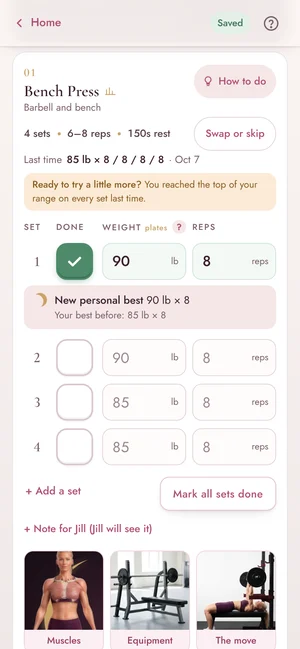
- A program written for you. Built around your starting point, your equipment, your schedule and any injuries, not the same plan everyone gets.
- Progression. The weights, reps or exercises change as you get stronger. Resistance training works for older adults when it is progressive and individualized, according to the National Strength and Conditioning Association’s position statement.
- A weekly check-in with real feedback. Not just “great job,” but what to change next week and why.
- Form review. You film a set; they tell you what to fix. In older adults, supervised training improved strength and balance more than training alone, so feedback is worth paying for.
- A plan that bends. When you travel, get sick or have a hard week, the plan changes so you don’t quit it.
- A clear way to reach them between check-ins, with a stated reply time.
Can an online fitness coach help with nutrition?
Yes, within limits, and a good coach will tell you where those limits are. Trainers can give general nutrition guidance on performance, weight loss and gain, and correct the misinformation you see online. Nutrition care for a disease that diet affects, called medical nutrition therapy, belongs to a registered dietitian or licensed nutritionist, depending on your state.
So if you have diabetes, heart disease, osteoporosis, a digestive condition or a history of disordered eating, a good coach should work alongside your doctor or a dietitian, not around them. For most women over 40, the useful help is practical: a protein target, meals that hit it, and someone noticing when your weekends undo your weekdays. You can find your own starting number with the free protein calculator.
What are the red flags?
- Guaranteed results. “Lose 20 pounds in 30 days” is a promise nobody can keep for your body.
- Dramatic before-and-afters with no context. The FTC warns that advertisers cherry-pick their best cases, and says ads showing unusual weight loss must disclose what typical results are. “Results may vary” alone isn’t enough.
- Reviews that feel too perfect. Since 2024, an FTC rule bans fake reviews, AI-written testimonials and reviews by insiders who don’t disclose their connection. If every review sounds the same, be skeptical.
- Crash diets or very low calories. After 40 you need enough food, especially protein, to keep and build muscle.
- A supplement you have to buy. Coaching that comes bundled with a product to sell is selling the product.
- Hours of cardio as the main plan. Strength training should be the core of a program for women over 40.
- “Push through the pain.” Effort is good; pain that gets worse is a reason to change the plan and, if it persists, see a professional.
- Terms they won’t put in writing.
What should you check in the fine print?
Before you pay, get these answers in writing: the monthly price and what it includes; the minimum length; whether it renews automatically; whether you can pause; what leaving early costs; and whether tax is added. Longer plans often cost less per month, which is fine if the terms are clear. The cost guide has the full list of money questions.
Ask to see the program or the app before you sign up. A coach who is proud of what they deliver will show you.
How do you know it’s working after the first month?
Don’t judge a coach by the scale after four weeks. Judge the coaching:
- You know exactly what to do in every session.
- Some weights or reps have gone up.
- Your check-ins get answered with specifics, on time.
- When a week went sideways, the plan changed.
- You feel more confident in the moves than when you started.
Body changes take longer and show up in more places than the scale. How to track progress beyond the scale shows what to measure in the meantime.
The checklist
| Check | What good looks like |
|---|---|
| Certification | Recognized organization, current, and they tell you which exam |
| Experience | Many clients over 40, specific answers about perimenopause and menopause |
| Program | Written for you, reviewed and progressed on a schedule |
| Check-ins | Every week, with feedback on what to change |
| Form | Video review included, with a stated number per month |
| Nutrition | Practical targets and meals; refers out for medical conditions |
| Marketing | No guarantees, no product to buy, typical results shown honestly |
| Terms | Price, length, renewal, pause and cancellation in writing |
Take this checklist into every consult call, including one with me. Request a free consult and ask me every question on it; you choose a plan only after the call, with no pressure. In your 50s or 60s? See what working with an online personal trainer for women over 50 looks like.
Common questions
What questions should I ask an online fitness coach before hiring?
Ask who certified them, how many of their clients are women over 40, how often they review your program, what a weekly check-in includes, how they handle form feedback and nutrition, and the full terms: price, minimum length, renewal, pausing and cancelling. A good coach answers all of it plainly, in writing.
Does an online fitness coach need to specialize in women over 40?
Not on paper, but they should have real experience with it. Ask how many of their clients are in perimenopause or menopause and what they change for that stage, such as sleep, recovery, joint aches and protein. A vague answer tells you a lot.
Can an online fitness coach give me a meal plan?
A trainer can give general nutrition guidance, like protein targets, portions and healthy swaps. If you have a condition that diet affects, such as diabetes, heart disease, osteoporosis or a history of disordered eating, a good coach will work alongside a registered dietitian or your doctor rather than prescribe a diet on their own.