Choosing support
Online coaching, a personal trainer or an app: which fits you after 40?
You’ve decided to get stronger. Now you’re staring at three very different ways to do it: a trainer at the gym, an online coach, or an app on your phone. Each one works for some women and fails others. Here’s an honest look at all three, including the one I don’t offer.
The three options at a glance
Prices vary by city and by person, so treat these as rough ranges.
| Option | Typical cost | Accountability | Flexibility |
|---|---|---|---|
| In-gym personal trainer | About $40–$100+ a session | High, during sessions | Low: set times, one place |
| Online strength coaching | About $100–$400 a month | High, every week | High: any time, home or gym |
| Workout app | Free to about $30 a month | Low: reminders only | High |
An in-gym personal trainer
A good trainer standing next to you is real value. They can see your form from every angle, adjust your hips with a light touch, load the bar, and spot you on a heavy set.
The trade-offs are cost and schedule. At $40 to $100 or more a session, two sessions a week can easily run several hundred dollars a month, which is why many women buy a package, use it up, and stop. You train when the trainer is free, at their gym. And the accountability mostly lives inside the session: what you eat, how you sleep and whether you train on your own days usually isn’t part of the deal. Plenty of trainers don’t cover nutrition at all.
Best for: a woman who wants someone physically beside her for every workout, has a flexible schedule near a gym she likes, and has the budget to keep going for months, not weeks.
Online strength coaching
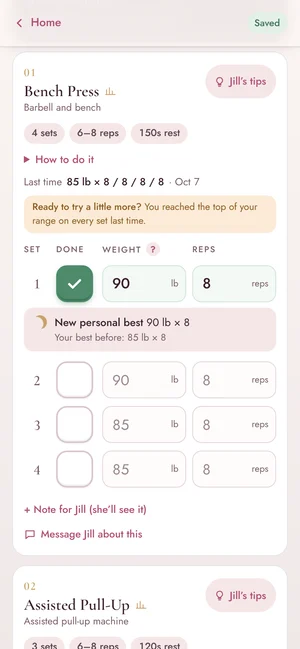
An online coach writes your program around your body, your equipment and your schedule, then checks in with you regularly to see how it’s going and change it. Good coaching usually includes nutrition targets, video form checks and messaging between check-ins.
The cost sits in the middle, roughly $100 to $400 a month depending on how much of the coach’s time you get. You train when it suits you, at home, in a gym or in a hotel on a work trip. Accountability is spread across the whole week: your coach sees whether you trained, what you ate and how you felt, not just how one hour went.
The honest downside: nobody is physically there. Form feedback comes from video, a little after the fact, and you have to show up for your own sessions. If you need someone in the room to get you through the door, it may not be enough on its own.
Best for: a woman with a busy or unpredictable week who wants a plan built for her, nutrition included, and a real person who notices when she drifts.
A workout app
Apps are cheap, always available and often well designed, with structured workouts, demo videos and a log to watch your weights go up. If you already train consistently, one can be enough.
What an app can’t do is notice you. It doesn’t know your knee has been grumbling, that you’re in perimenopause and sleeping badly, or that you’ve skipped two weeks. Most programs are written for a general audience, not for a 52-year-old returning to lifting. And “accountability” is usually a push notification, which is easy to swipe away.
Best for: a self-motivated woman with some lifting experience, a tight budget, and no need for feedback on form or food.
What matters most after 40
Whichever you choose, make sure it delivers three things that matter more after 40:
- Progressive strength training. Your muscle and bone respond to weights that get heavier over time. A plan that stays at the same light dumbbells forever won’t do it. (The lifting heavy guide explains how heavy.)
- Enough protein. Training without enough protein leaves results on the table. Many trainers and most apps skip this. Use the protein calculator to find your number.
- Someone who adjusts the plan. Hormones, sleep, joints and life change week to week in this phase. The plan has to bend so you don’t quit it.
Supervision also seems to matter for results, not just motivation. A review of trials in older adults found that supervised strength and balance programs improved strength more than the same programs done unsupervised, even though attendance was about the same.
How to choose
Ask yourself what has stopped you before:
- “I don’t know what to do.” Any of the three fixes this. An app is cheapest.
- “I start strong and fade by week three.” You need accountability that lasts all week. Coaching or a trainer, not an app.
- “My schedule changes every week.” Fixed appointments will fight you. Online coaching or an app.
- “I train fine, but my body isn’t changing.” That’s often nutrition. Look for support that covers food, which usually means coaching.
- “I’m scared of hurting myself.” Look for real form feedback, live or by video, and a program that starts where you are.
Questions to ask before you pay anyone
- Are you certified, and by whom?
- How many of your clients are women over 40? What do you change for perimenopause and menopause?
- Is the program written for me, or is it the same one everyone gets?
- Do you help with nutrition, including protein?
- What happens when I miss a week?
- What does it cost each month, and what’s the commitment?
If online coaching sounds like the right fit, request a free consult call to talk it through.
Common questions
Is online coaching as effective as a personal trainer?
It can be, if the program progresses, you get regular form feedback by video, and someone checks in every week. What drives results is a good plan you actually follow for months, and both options can provide that.
Can I learn proper form without someone in the room?
Yes, for most women. Start with lighter weights, film your sets from the side, and have a coach review them. Simple moves like the five starter moves are well suited to learning this way.
How much does online coaching cost?
Roughly $100 to $400 a month, depending on how much of the coach’s time you get. You can see exactly what my coaching costs and what each level includes on the pricing page.