Tracking progress
How to track progress after 40, beyond the scale
The scale is the number most of us check first and trust most. It’s also the one most likely to make you quit a plan that’s working. Here are five better ways to measure progress after 40, and how often to check each one.
Why is the scale misleading after 40?
A scale tells you one thing: how much all of you weighs at that moment. It can’t tell muscle from fat, and it can’t tell either of them from the water, salt and food you’ve had in the last day. It’s normal for that number to move a couple of pounds from one morning to the next for reasons that have nothing to do with your progress.
The bigger problem shows up when you start lifting. From around age 30, adults lose about 3–5% of their muscle mass per decade unless they train to keep it. Strength training is how you turn that around, and research shows that building muscle while losing fat at the same time, called body recomposition, is well documented. But if you gain two pounds of muscle and lose four pounds of fat, the scale says you lost two pounds. Your body changed a lot more than that.
That’s why so many women do everything right for six weeks, see the scale barely move, and decide it isn’t working. Usually it is. They’re just measuring the wrong thing. The full picture of losing fat and building muscle together is in body recomposition for women over 40.
How do you track strength progress?
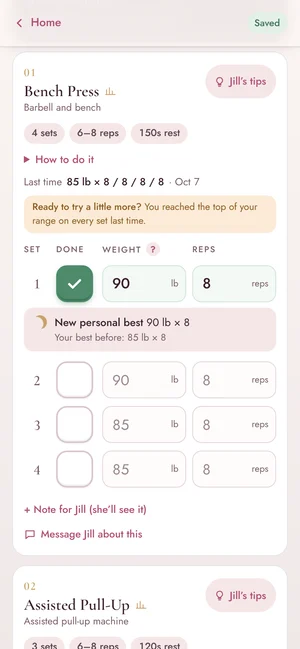
Your lifts are the most direct proof that you’re building muscle. If the weight on your goblet squat goes from 20 pounds to 35, your legs changed. No scale can argue with that.
Every session, write down the move, the weight and the reps. A notebook is fine, and so is the notes app on your phone. Then, about once a month, look back at where you started.
Don’t expect a new record every week. Some weeks you’ll add a rep, some weeks you’ll repeat last week. Over a month, the trend should be up. If it’s been flat for a month or more, look at your sleep, your protein and how hard your sets really are. New to lifting? The five moves to start with make good marker lifts.
Which body measurements should you take, and how often?
A soft tape measure is cheap, quick, and far more useful than the scale. Measure every two weeks, on the same day, at the same time, before you eat. First thing in the morning works well.
- Waist. Around your middle at the level of your belly button, standing relaxed. Don’t suck in.
- Hips. Around the widest part of your bottom, feet together.
- Optional. One thigh and one upper arm, at the same spot each time.
Keep the tape snug but not pressing into the skin, and measure twice. If the two readings differ, take a third and use the middle one. A quarter or half an inch is real progress when it keeps heading the same way.
Your waist is often the most telling number in perimenopause and menopause, because that’s where many women notice fat collecting. If that’s your main concern, menopause belly: what actually works goes deeper.
How do you take useful progress photos?
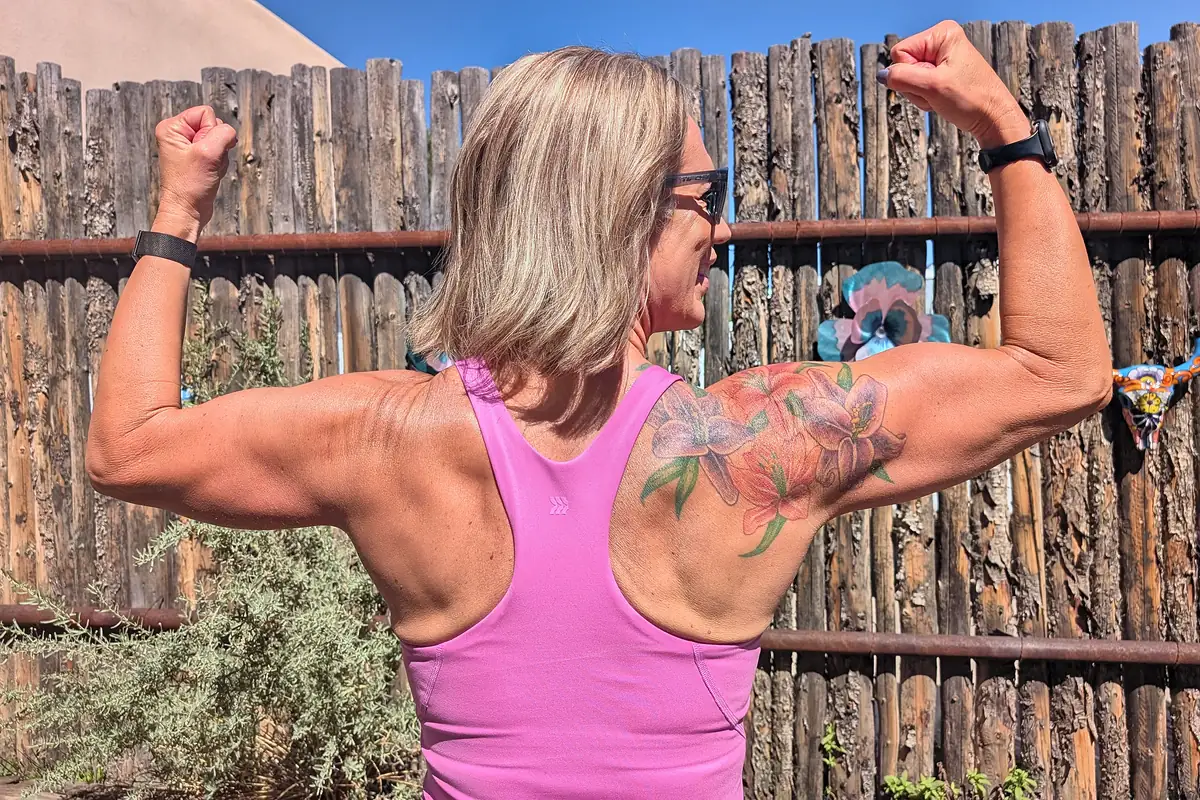
You see yourself every day, so you’ll miss slow change. A photo every four weeks catches what the mirror doesn’t: a different line through your shoulders, more shape in your back, a waist that sits differently in a side view.
The secret is keeping everything the same, so the only thing that changes is you:
- Same setup. Same spot, same light, same time of day.
- Same clothes. Ideally something fitted, like leggings and a sports bra.
- Three angles. Front, side and back. A phone timer or a friend helps with the back.
- Relaxed. Stand naturally, not posed or flexed.
Then put them away. Don’t compare week to week. Compare month one to month three, side by side. And these are for you. Nobody else ever needs to see them.
Is how your clothes fit a good measure of progress?
Yes, and it’s one of the most honest there is. Pick one pair of jeans or trousers without stretch that are snug right now. Try them on once a month, and notice the waistband, the thighs and how they feel when you sit down.
Most women notice this change early, often while the scale is barely moving. It’s also the change other people tend to pick up on first, because a different shape shows up in how clothes hang.
How do you track energy and how you feel?
This one never shows up in a before-and-after photo, and it may be the one you care about most. Are you less wiped out by mid-afternoon? Do stairs, carrying the groceries or getting up off the floor feel easier? Are you sleeping a bit better?
Once a week, give a few things a quick score from 1 to 5:
- Energy through the day
- Sleep quality
- Mood
- Strength, meaning how capable you feel in everyday life
It takes thirty seconds. Over a couple of months, those scores tell a story you’d otherwise forget, because once you feel better, it’s easy to lose track of how you felt before.
What does a simple tracking routine look like?
| What | How often | How |
|---|---|---|
| Strength | Every session | Move, weight and reps in a notebook or app |
| Energy | Weekly | Rate energy, sleep, mood and strength 1–5 |
| Measurements | Every 2 weeks | Waist and hips, same morning routine |
| Photos | Every 4 weeks | Front, side and back; same spot and light |
| Clothes | Monthly | The same snug pair of jeans |
That’s five minutes a week, plus a few minutes once a month. If even that feels like a lot, start with your strength numbers and your waist. Those two alone tell you most of the story.
Should you stop weighing yourself?
Not necessarily. If you like the data, weigh yourself a few mornings a week under the same conditions and look at the weekly average, not single days. Treat it as one number among several, never the verdict on whether you’re making progress.
If the scale wrecks your mood or makes you want to eat less than your body needs, put it in a cupboard for a few months. The other five measures will tell you what you need to know. Eating too little, especially too little protein, makes the muscle you’re working for much harder to build.
Start this week: write down three marker lifts, measure your waist and take one set of photos. Use the protein calculator to set a daily target so your training has something to build with. And if you’d like someone to read the numbers with you every week, book a free consultation call.
If you’re seeing changes in weight, energy or sleep that worry you or don’t make sense, talk with your doctor.
Common questions
Why am I not losing weight when I’m strength training?
The scale can’t tell muscle from fat. If you’re building muscle while losing fat, your weight can stay flat even as your waist shrinks and your clothes fit differently. Track your lifts, your waist and a monthly photo for a truer picture.
How often should I measure my waist?
Every two weeks, on the same day and at the same time, ideally first thing in the morning before you eat. Measure at your belly button, standing relaxed, and take two readings.
How often should I take progress photos?
Every four weeks, in the same spot, light and clothes, from the front, side and back. Compare photos a few months apart rather than week to week.