Exercise after 60
Exercises for women over 60: strength first, then walking and balance
There’s no shortage of exercise advice for women over 60, and most of it is gentle to the point of not doing much. This guide puts things in the order that matters: eight strength exercises first, then how much to walk, then a few minutes of balance work, with a weekly plan that fits all three.
Why should women over 60 do strength exercises first?
The National Institute on Aging lists four types of exercise older adults need: endurance, strength, balance and flexibility. Many women over 60 already walk. Strength is the one that usually gets skipped, and it’s the one that makes the other three easier.
- Muscle loss adds up. From around 30 the body loses about 3–5% of its muscle per decade, and it often becomes noticeable by 60, in stairs, jars and getting up off the floor.
- Strength is linked to how long you live well. In more than 5,400 women aged 63 and older, stronger grip and faster chair stands were both linked to a lower risk of dying over eight years.
- Balance and leg strength together help prevent falls. A Cochrane review of 59 trials found exercise cut the rate of falls in older adults by 23%. Balance and functional exercises, like sit-to-stands and step-ups, did the most, especially combined with strength training.
The CDC’s guidance for older adults puts it in order: at least two days a week of strength work, 150 minutes of moderate activity such as walking, and activities that improve balance. Here’s each part.
What are the best strength exercises for women over 60?
These eight cover your whole body: legs, hips, back, chest, shoulders and grip. Start with two sets of 8–12 of each, with a minute’s rest between sets. You need a sturdy chair, a wall or kitchen counter, a resistance band and a few dumbbells.
1. Sit-to-stand
Sit near the front of a sturdy chair, feet flat and hip-width apart. Lean forward slightly and stand up without using your hands, then sit back down slowly.
Cue: Push the floor away through your whole foot. Easier or harder: Use your hands on your thighs to start. When ten feel easy, hold a dumbbell at your chest; that’s a goblet squat.
2. Step-up
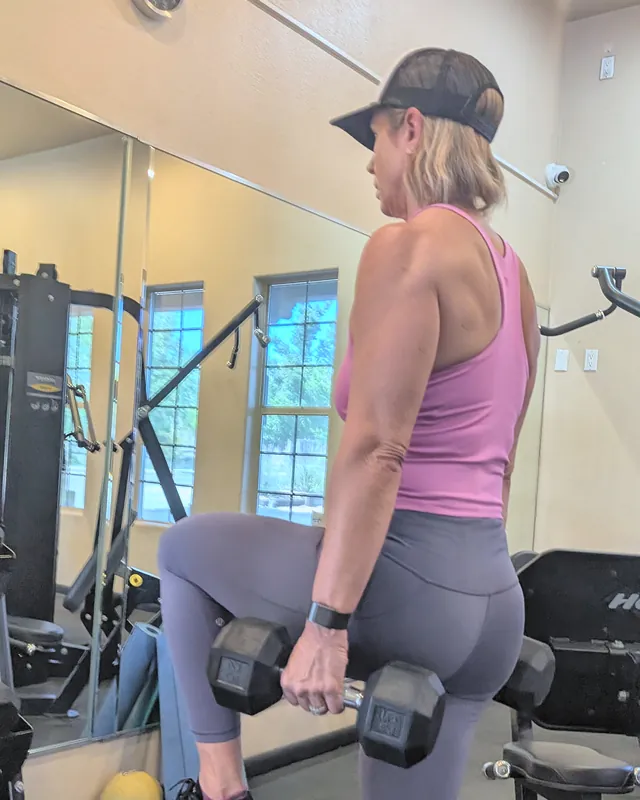
Stand facing a bottom stair or a low, sturdy step. Step up with one foot, press through that heel to bring the other foot up, then step down with control. Do all your reps on one side, then switch.
Cue: Let the front leg do the work, not a push off the back foot. Easier or harder: Hold a rail or wall for balance. Progress to a higher step or a dumbbell in each hand.
3. Hip hinge (Romanian deadlift)
Stand tall with a light dumbbell in each hand. Push your hips back, letting the weights slide down the front of your thighs to just below the knee, with your back flat. Squeeze your glutes to stand back up.
Cue: Hips go back, not down. Keep the weights close to your legs. Easier or harder: Learn it with no weight and your hands on your hips. Add weight as the movement feels steady.
4. Glute bridge
Lie on your back with knees bent and feet flat. Press through your heels to lift your hips until your body makes a straight line from shoulders to knees, pause, and lower slowly.
Cue: Ribs down; squeeze your glutes at the top rather than arching your back. Easier or harder: If getting to the floor is hard, do it on a firm bed. Progress to one leg at a time.
5. Wall or counter push-up
Place your hands on a wall or the edge of a kitchen counter, a little wider than your shoulders. Walk your feet back, lower your chest toward your hands with your body in a straight line, then press away.
Cue: Keep your body in one line, like a plank. Easier or harder: The lower the surface, the harder it gets: wall, then counter, then a sturdy bench.
6. Band or dumbbell row
Anchor a resistance band at chest height (or around a sturdy post) and step back until it’s taut. Pull your hands to your ribs, squeezing your shoulder blades together, then return slowly. Or row one dumbbell with your other hand on a bench or table.
Cue: Elbows back toward your hips; shoulders away from your ears. Easier or harder: Step farther from the anchor or use a heavier dumbbell.
7. Seated overhead press
Sit tall in a chair with a light dumbbell in each hand at shoulder height. Press them straight up until your arms are almost straight, then lower slowly.
Cue: Ribs down; don’t lean back to finish the rep. Easier or harder: Start with one arm at a time. Progress by standing up, or with heavier weights.
8. Farmer’s carry
Pick up a heavy dumbbell or a full grocery bag in each hand and walk 20–40 steps, standing tall. Set them down, rest, and repeat two or three times.
Cue: Walk tall, shoulders back, steady steps. Easier or harder: Start with one bag in one hand (switch sides). Progress to heavier weights or longer walks.
The strength training for women over 60 guide covers how to start if you’ve never lifted, and the five moves guide has more form cues.
How hard should the exercises feel?
Harder than most women over 60 were told. The National Strength and Conditioning Association’s guidance for adults 65 and older is to build up to two or three sets at a weight you could lift roughly 8–12 times, two or three times a week. In the LIFTMOR trial, women averaging 65 with low bone mass built up to heavy lifting under supervision and raised their spine bone density, while the low-intensity group lost some.
Spend the first two or three weeks learning the moves with light weight. Muscle soreness a day or two later is normal at first and fades. Sharp pain in a joint is not; stop that exercise and try the easier version.
How much should women over 60 walk?
Aim for 6,000–8,000 steps a day, or at least 150 minutes a week of brisk walking. In a large analysis of 15 studies, the drop in risk of early death for adults 60 and older kept going until about 6,000–8,000 steps a day and then leveled off. You don’t need 10,000.
- Start from where you are. Check your average for a week, then add about 1,000 steps a day. Hold that for a week or two before adding more.
- Break it up. A 10-minute walk after each meal adds up to 30 minutes a day.
Wondering whether you need other cardio? Cardio vs strength after 40 covers how much is useful.
What are the best balance exercises for women over 60?
Balance is a skill, and it improves with practice. The CDC’s examples are simple ones like standing on one foot and walking heel to toe. Do these next to a counter, two or three times a week, after a walk:
- Single-leg stand. Hold the counter lightly and stand on one foot for up to 30 seconds, then switch. When that’s easy, let go; later, try it with your eyes closed.
- Heel-to-toe walk. Walk 10–20 steps placing one heel directly in front of the other toes, like on a tightrope. Use the wall for support at first.
- Slow sit-to-stands. Take three seconds to sit down and three to stand. Control is the point.
- Step-ups and carries. Both from the strength list train balance too, because you’re supporting weight on one leg at a time.
Finish with a few gentle stretches for your hips, calves and chest, holding each for about 30 seconds. Flexibility is the fourth type of exercise on the National Institute on Aging’s list.
What does a week of exercise look like after 60?
| Day | What you do | Time |
|---|---|---|
| Monday | Strength: all eight exercises, 2–3 sets each | 35–40 min |
| Tuesday | Walk, plus balance exercises | 35–45 min |
| Wednesday | Walk | 30 min |
| Thursday | Strength: all eight exercises | 35–40 min |
| Friday | Walk, plus balance exercises | 35–45 min |
| Weekend | A longer walk, gardening, swimming or rest | — |
That covers the CDC’s guidance for older adults: two strength days, at least 150 minutes of walking and regular balance work. Add a third strength day once the first two feel routine. For a version with separate A and B workouts and a bit more cardio, workouts for women over 50 works just as well at 60, started a little lighter.
Talk to your doctor before you start if you have a heart condition, uncontrolled blood pressure, osteoporosis with a past fracture, or a joint replacement. Exercise is usually still possible; the starting point changes.
If you’d like these exercises put together for your body, your equipment and any limits your doctor has given you, with someone checking in every week, request a free consult call.
Common questions
How often should a woman over 60 exercise?
Something most days. Do strength exercises two or three days a week, walk for at least 150 minutes a week in total, and add balance exercises a few times a week. That matches the CDC’s guidance for older adults.
What is the best exercise for a woman over 60?
Strength training, because it is the type most women skip and it makes walking, balance and everyday life easier. The National Institute on Aging lists four types of exercise older adults need: endurance, strength, balance and flexibility.
How many steps a day should a woman over 60 walk?
Around 6,000 to 8,000. In a large analysis of 15 studies, the drop in risk of early death for adults 60 and older leveled off in that range. If you walk less now, add about 1,000 steps a day every week or two.
Can exercise help prevent falls after 60?
Yes. A Cochrane review of 59 trials found exercise reduced the rate of falls in older adults living at home by 23%. Balance and functional exercises, especially combined with strength training, worked best.