Cardio
Cardio vs strength after 40: do you still need cardio?
Most of us grew up believing cardio was how you got in shape. More classes, more miles, more sweat. After 40 that plan stops working for a lot of women, and the question I hear most is whether to give cardio up entirely. You don’t have to. You just have to put it in the right place.
Why lifting comes first after 40
Cardio and strength training do different jobs, and after 40 the strength job gets more urgent. Muscle starts slipping away around 30, at roughly 3–5% per decade if nothing is done about it. By your 40s and 50s that adds up, and it is the part of fitness that cardio does not rebuild. You can walk, spin and run for years and still lose muscle.
Lifting is what tells your body to keep it. It is also what changes your shape, makes everyday things like carrying groceries and getting up off the floor easier, and gives you a number that goes up every week, which is a lot more motivating than a scale that won’t move.
So when time and energy are limited, and they always are, the weights get the first slot in your week. Cardio fills in around them. Not the other way round.
Where walking fits
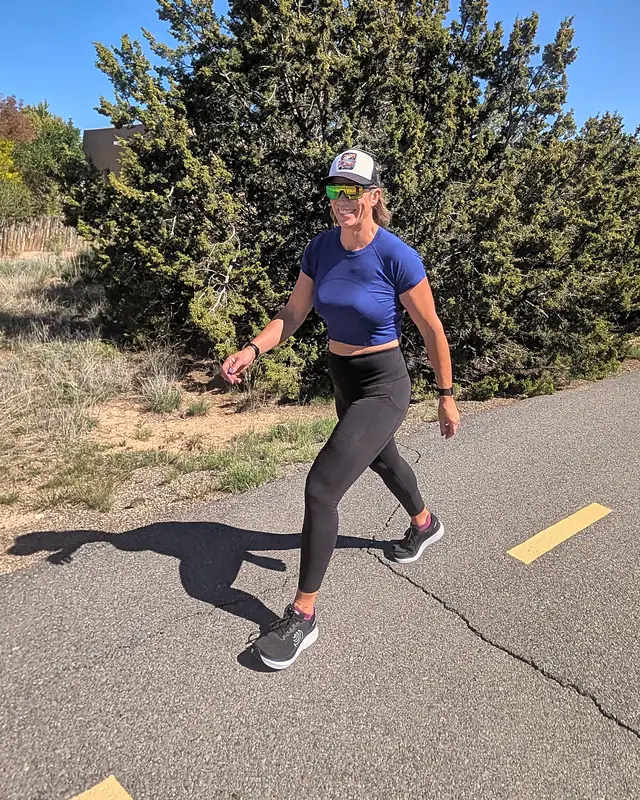
Walking is the cardio I want almost every woman over 40 doing, because it gives you most of what cardio offers and takes almost nothing away from your lifting. It doesn’t leave your legs wrecked for squat day. It doesn’t need a class schedule. It’s easy on your joints, and you can do it on a rest day without cutting into your recovery.
The research backs this up. A 2025 analysis of 57 studies found that around 7,000 steps a day was linked to better health outcomes than about 2,000, and you don’t need to run to get there. I aim for 8,000–10,000 myself, but 7,000 is a great first target if you’re starting lower.
A few ways to fit it in without adding a workout:
- A 10–20 minute walk after dinner. Short enough to do most nights, and it adds up.
- A walk on your non-lifting days. 30–45 minutes at a pace where you can talk but would rather not sing.
- Hills or a trail once a week. This is the simplest way to make walking harder without turning it into a hard workout.
How much cardio is useful?
The CDC’s baseline for adults is at least 150 minutes a week of moderate activity, like brisk walking, plus at least two days of muscle-strengthening work. That is the target I build around, and it breaks down simply:
| Type | How much | Why |
|---|---|---|
| Strength training | 2–3 sessions a week | Builds and keeps muscle; the non-negotiable |
| Walking | Most days, about 7,000+ steps | Covers your 150 minutes, helps recovery and energy |
| Harder cardio | 0–1 session, about 20 minutes | Optional, for fitness and fun |
If you’re walking 30 minutes five days a week, you’ve already hit the 150. Harder cardio is a bonus, not a requirement. If you do it, keep it short: 20 minutes of intervals on a bike, rower or hill. And try not to put it the day before a lifting session, so your legs show up ready.
For the full weekly plan with exercises and balance work, see workouts for women over 50. It works just as well in your 40s.
A sample week
Here’s what a balanced week can look like in your 40s, 50s or 60s. Three lifting days, walking in between, and one optional harder session.
| Day | Workout | Time |
|---|---|---|
| Monday | Lift (full body) | 35–45 min |
| Tuesday | Brisk walk | 30–45 min |
| Wednesday | Lift (full body) | 35–45 min |
| Thursday | Walk, or 20 min intervals if you enjoy them | 20–45 min |
| Friday | Lift (full body) | 35–45 min |
| Saturday | Longer walk, hike, bike ride or swim | 45–90 min |
| Sunday | Rest, or an easy walk | — |
Plus an after-dinner walk most nights. Only have two lifting days? Make them Monday and Thursday and walk the rest. Two consistent lifting days beat three you keep skipping.
Not sure what to do on the lifting days? The free 12-week program writes it out session by session, and your first 30 days of lifting eases you in if you’re brand new.
What if you love running or classes?
Keep them. I’m not here to take away something that makes you happy. The goal is to stop using cardio as your whole plan. If you run, spin or dance, keep one or two sessions you love, add two lifting days, and let walking fill the rest. If something has to give in a busy week, drop a cardio session, not a lifting one.
If your class is the only time you get to the gym, arrive 30 minutes early and lift first. That one change turns a cardio habit into a strength habit, and the five moves to start lifting fill that half hour.
Signs the cardio is crowding out the weights
- Your lifts haven’t gone up in a month, even though you’re showing up.
- You’re too tired or sore from classes to lift with good effort.
- You’re always hungry, and the scale isn’t moving anyway.
- You skip lifting when you’re short on time, but never the class.
If two or more sound familiar, swap one hard cardio session for a walk and give that energy to the weights for four weeks. Then look at your lifts. Body recomposition explains why progress shows up in the mirror and the lifts before the scale, and the five pillars put lifting, protein, walking and sleep together in one plan.
Want help balancing it all around your schedule and the cardio you love? Book a free consultation call. Coaching is online, so it works wherever you are.
Common questions
Is walking enough cardio for women over 40?
For most women, yes. Brisk walking 30 minutes five days a week meets the CDC’s 150 minutes of moderate activity, and around 7,000 steps a day is a good target. Add one harder session only if you enjoy it.
Should I do cardio or weights first?
If you do both in one session, lift first while you’re fresh, then do your cardio. Over the week, schedule your lifting days first and fit cardio around them.
Can I lose weight after 40 without cardio?
Lifting, enough protein and a small calorie deficit do most of the work. Daily walking helps, but long, hard cardio sessions aren’t required.
How many days a week should I lift weights?
Two or three. Two consistent sessions a week are enough to start building strength, and three gives you more room to progress.